Cards to save for the hard moments
The short versions of our guides, made to screenshot and keep. Each one is in plain words, says when to get checked, and links to the full guide with the research behind it.
What to do when a panic attack starts
Four steps, with the loop that makes panic feel like it feeds itself, and when to get checked.
Read the cards as text
- What to do when a panic attack starts. Four steps. Read them now, while you're calm, so they're there when you need them.
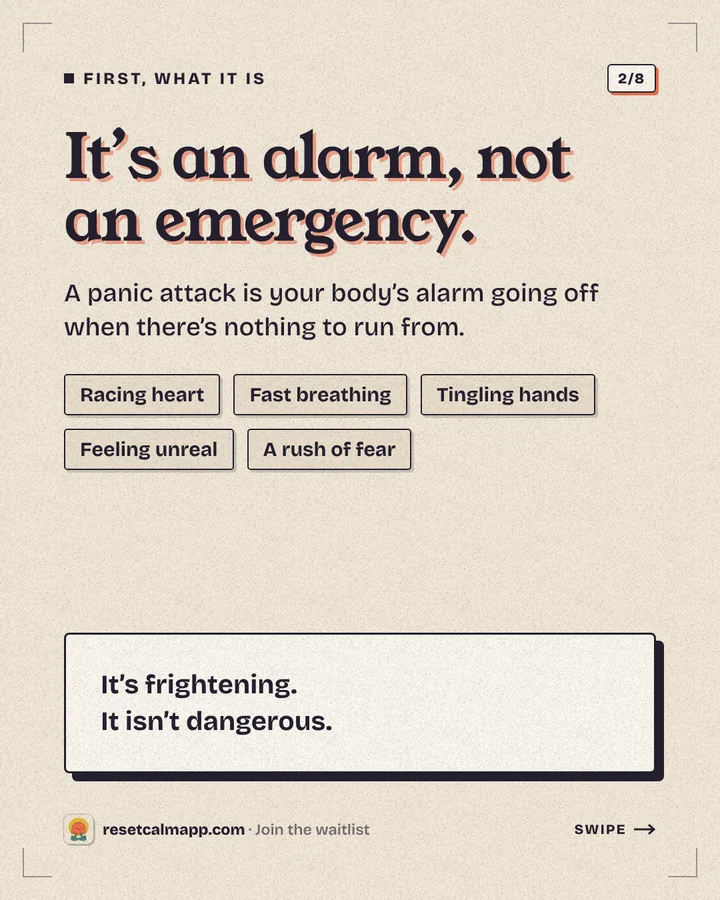
- It's an alarm, not an emergency. A panic attack is your body's alarm going off when there's nothing to run from: a racing heart, fast breathing, tingling hands, feeling unreal, a rush of fear. It's frightening. It isn't dangerous.
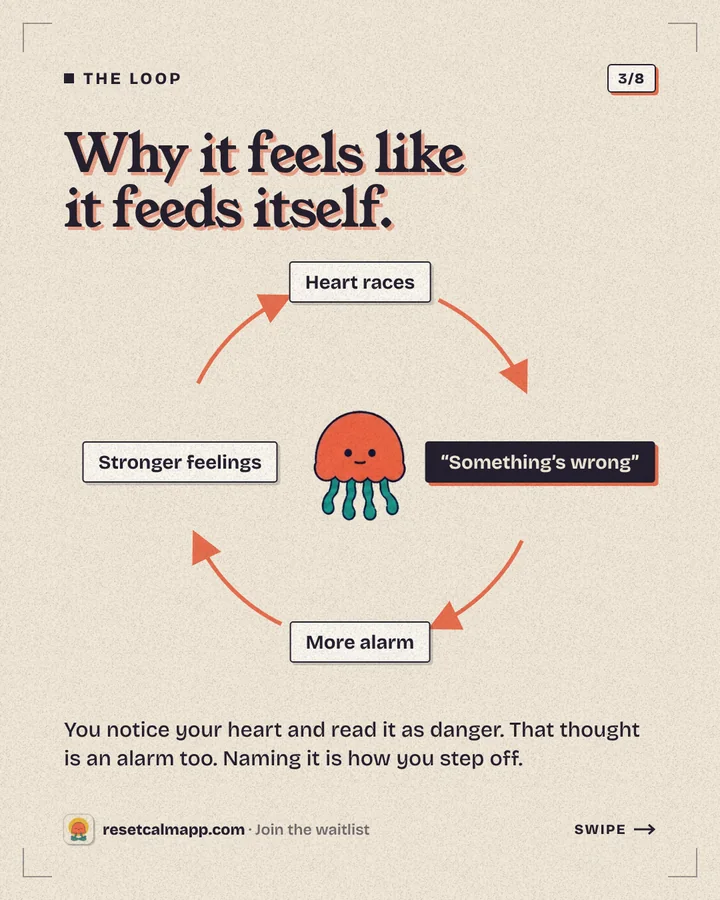
- Why it feels like it feeds itself. Your heart races, you think something's wrong, that sets off more alarm, and the feelings get stronger. You notice your heart and read it as danger. That thought is an alarm too. Naming it is how you step off.
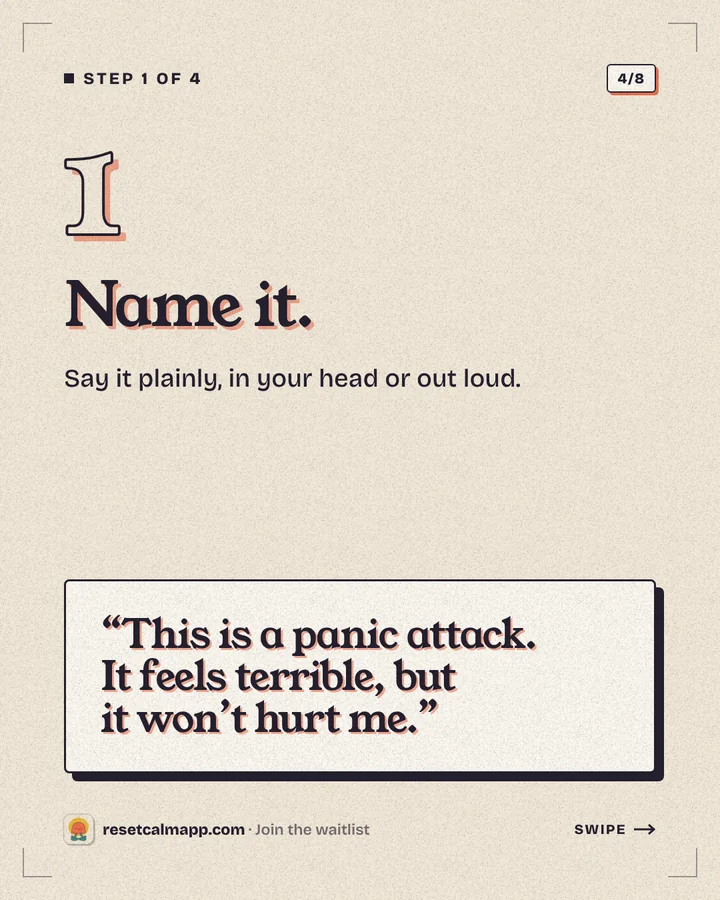
- Step 1 of 4: name it. Say it plainly, in your head or out loud: this is a panic attack. It feels terrible, but it won't hurt me.
- Step 2 of 4: stay where you are, if you can. You don't have to get anywhere or fix anything. Let it rise and fall right here.
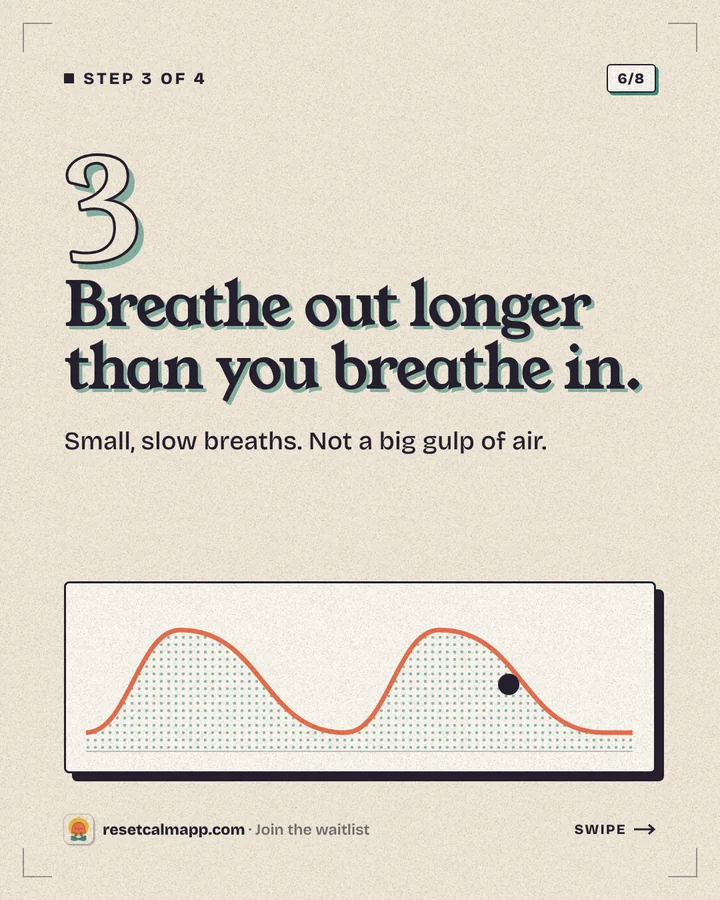
- Step 3 of 4: breathe out longer than you breathe in. Small, slow breaths. Not a big gulp of air.
- Step 4 of 4: remind yourself it will pass. Most panic attacks last between 5 and 20 minutes. The peak doesn't stay.
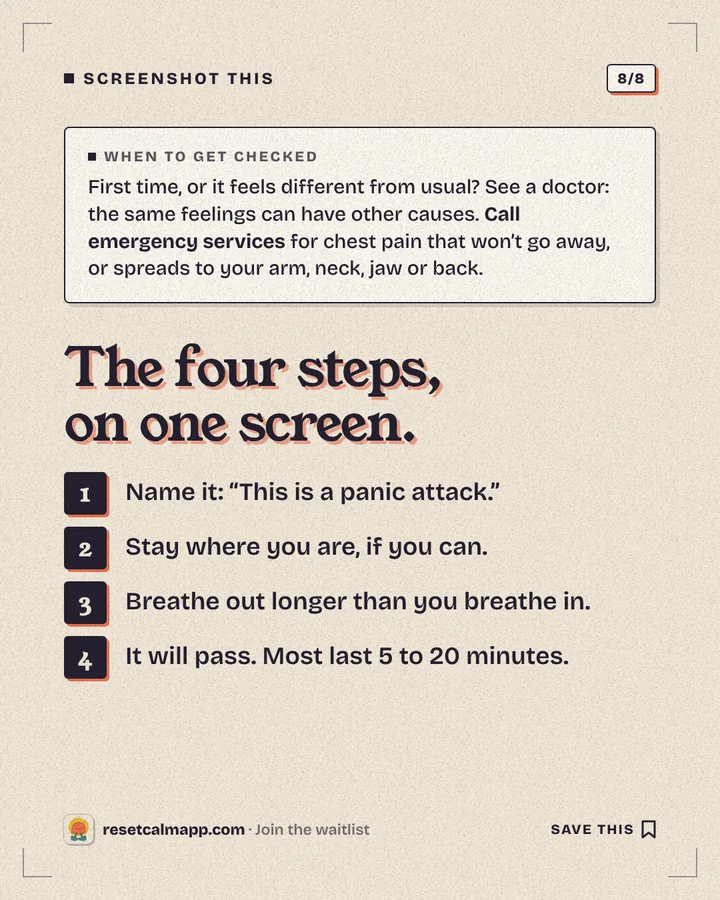
- When to get checked: if it's the first time, or it feels different from usual, see a doctor, because the same feelings can have other causes. Call emergency services for chest pain that won't go away, or that spreads to your arm, neck, jaw or back. The four steps on one screen: name it, this is a panic attack. Stay where you are, if you can. Breathe out longer than you breathe in. It will pass: most last 5 to 20 minutes.
Stop taking a deep breath
Why a big breath in can make anxiety worse, what air hunger is, and the slow breath out to do instead.
Read the cards as text
- Stop taking a deep breath. When you're anxious, a big breath in can make it worse. Here's what to do instead.
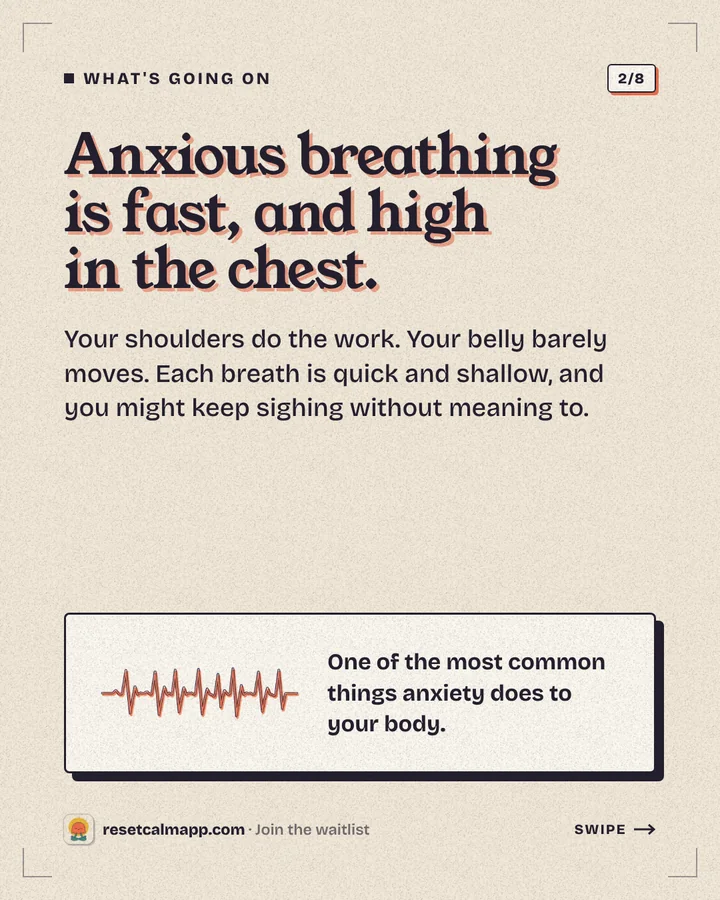
- Anxious breathing is fast, and high in the chest. Your shoulders do the work. Your belly barely moves. Each breath is quick and shallow, and you might keep sighing without meaning to. It's one of the most common things anxiety does to your body.
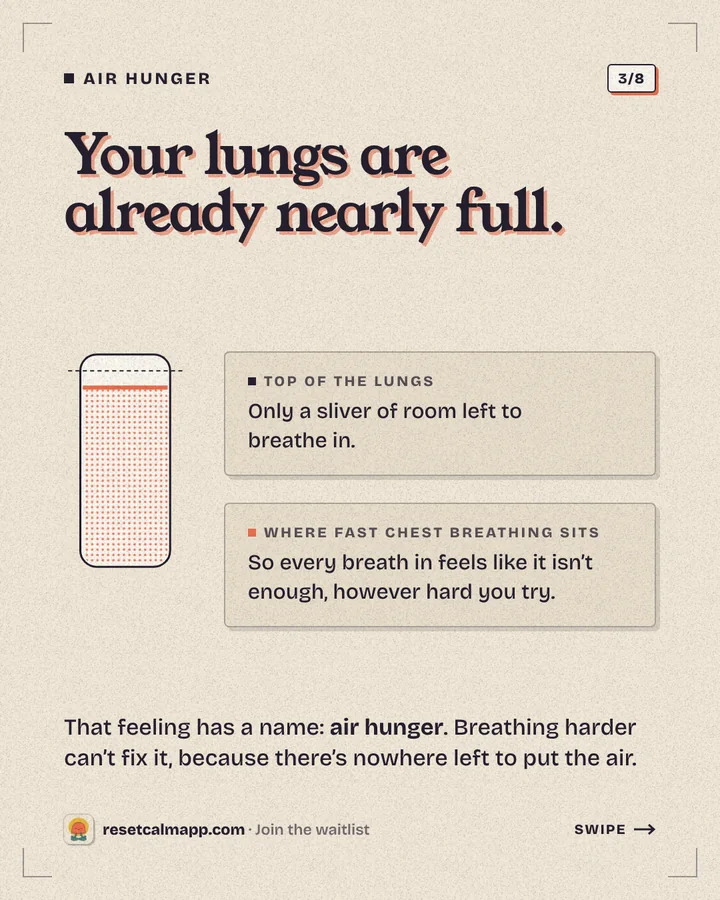
- Your lungs are already nearly full. Fast chest breathing sits near the top of what your lungs can hold, leaving only a sliver of room to breathe in, so every breath in feels like it isn't enough, however hard you try. That feeling has a name: air hunger. Breathing harder can't fix it, because there's nowhere left to put the air.
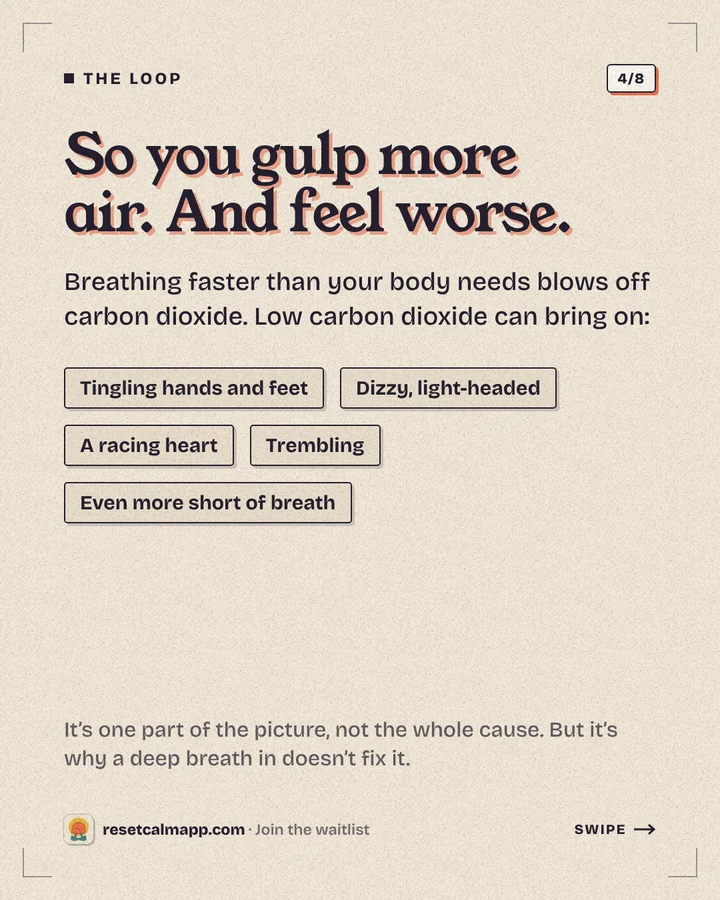
- So you gulp more air, and feel worse. Breathing faster than your body needs blows off carbon dioxide. Low carbon dioxide can bring on tingling hands and feet, dizziness, a racing heart, trembling, and even more shortness of breath. It's one part of the picture, not the whole cause. But it's why a deep breath in doesn't fix it.
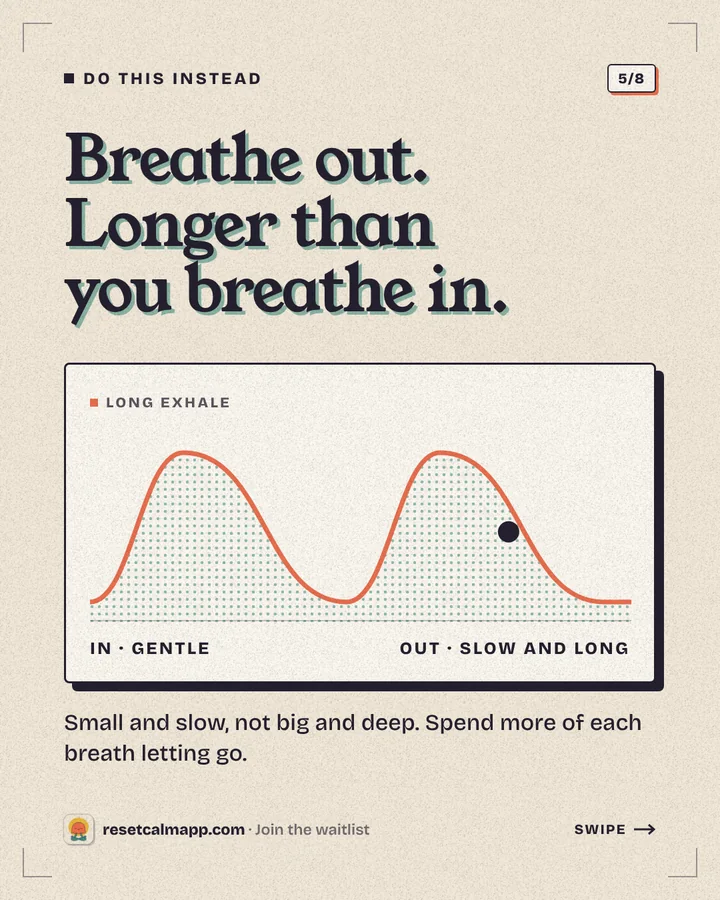
- Breathe out, longer than you breathe in. A long exhale: breathe in gently, then out slow and long. Small and slow, not big and deep. Spend more of each breath letting go.
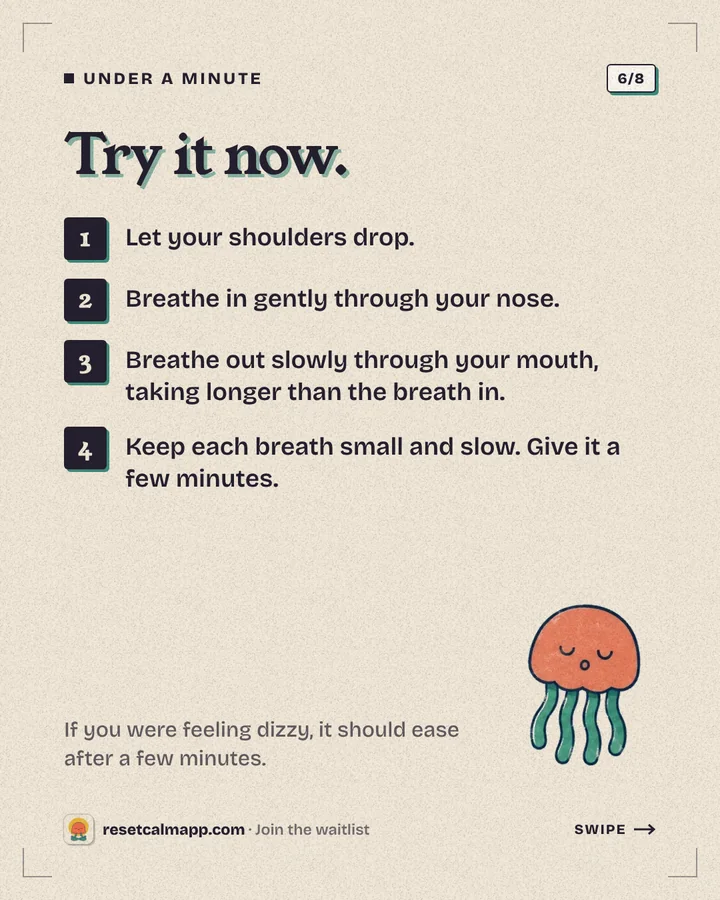
- Try it now. Let your shoulders drop. Breathe in gently through your nose. Breathe out slowly through your mouth, taking longer than the breath in. Keep each breath small and slow, and give it a few minutes. If you were feeling dizzy, it should ease after a few minutes.
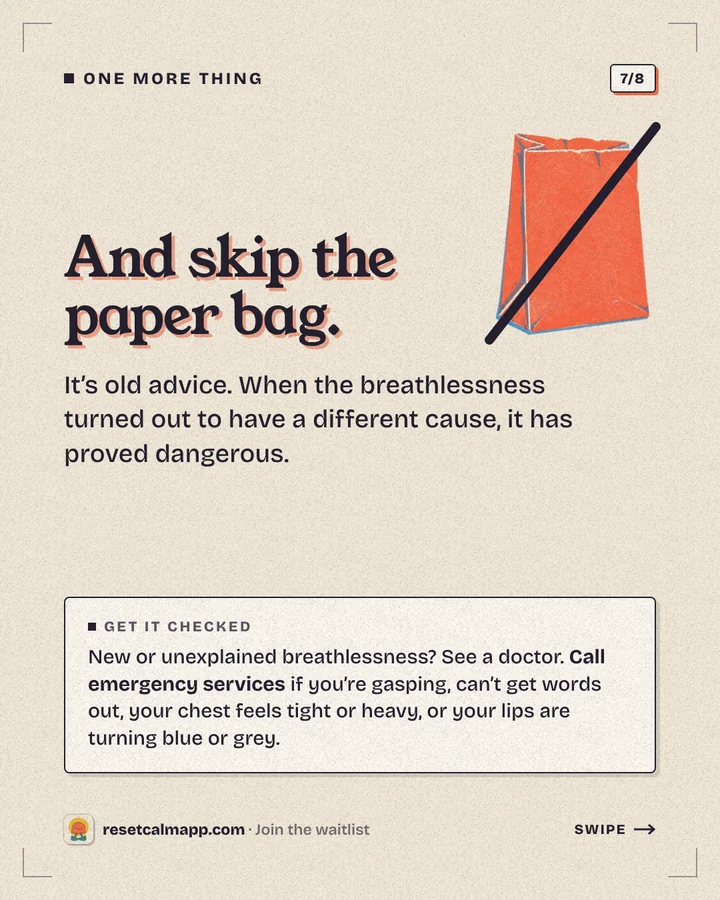
- And skip the paper bag. It's old advice, and when the breathlessness turned out to have a different cause, it has proved dangerous. New or unexplained breathlessness? See a doctor. Call emergency services if you're gasping, can't get words out, your chest feels tight or heavy, or your lips are turning blue or grey.
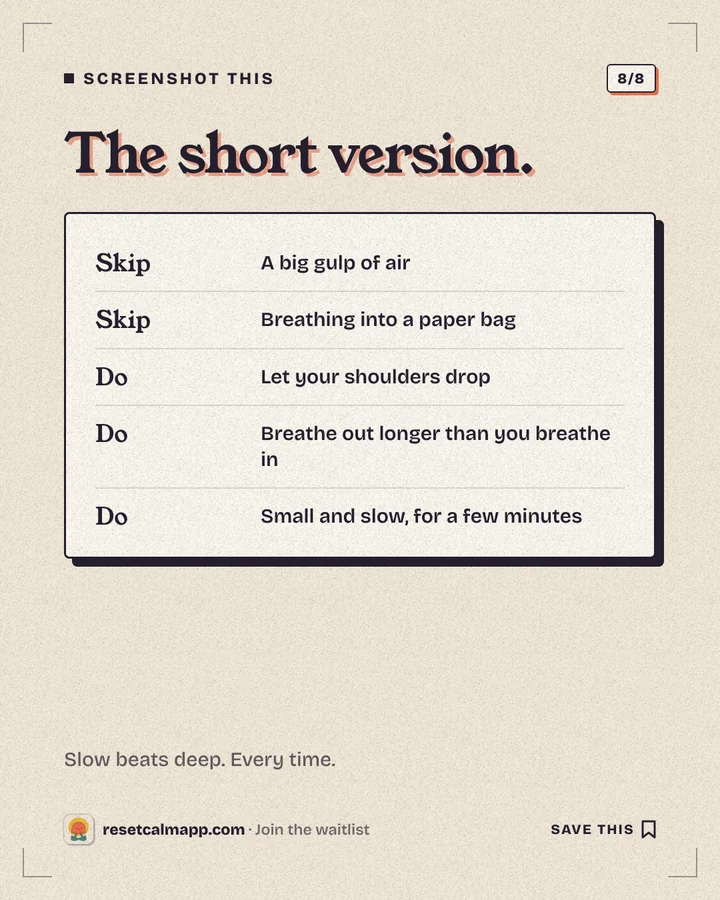
- The short version. Skip a big gulp of air. Skip breathing into a paper bag. Let your shoulders drop. Breathe out longer than you breathe in. Keep it small and slow, for a few minutes. Slow beats deep, every time.
 Reset
The calm app you don't look at. When it hits, press one button: Reset asks what's happening, out loud, then buzzes each breath, so you can shut your eyes.
Anxiety isn't one feeling
Flight, overload, freeze and fight: how to tell which one you're in, and what to try first for each.
Read the cards as text
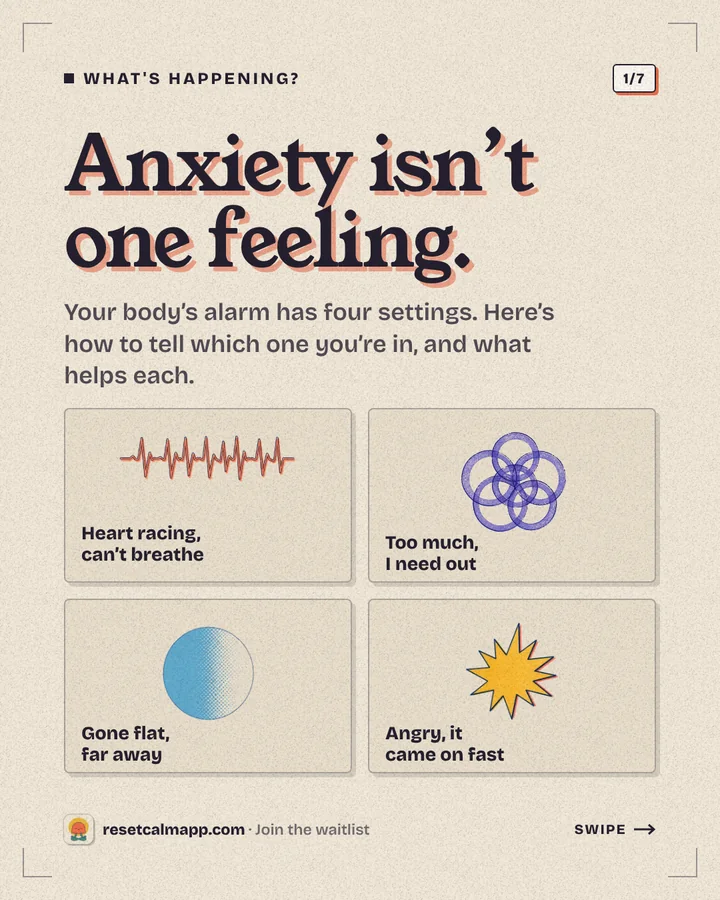
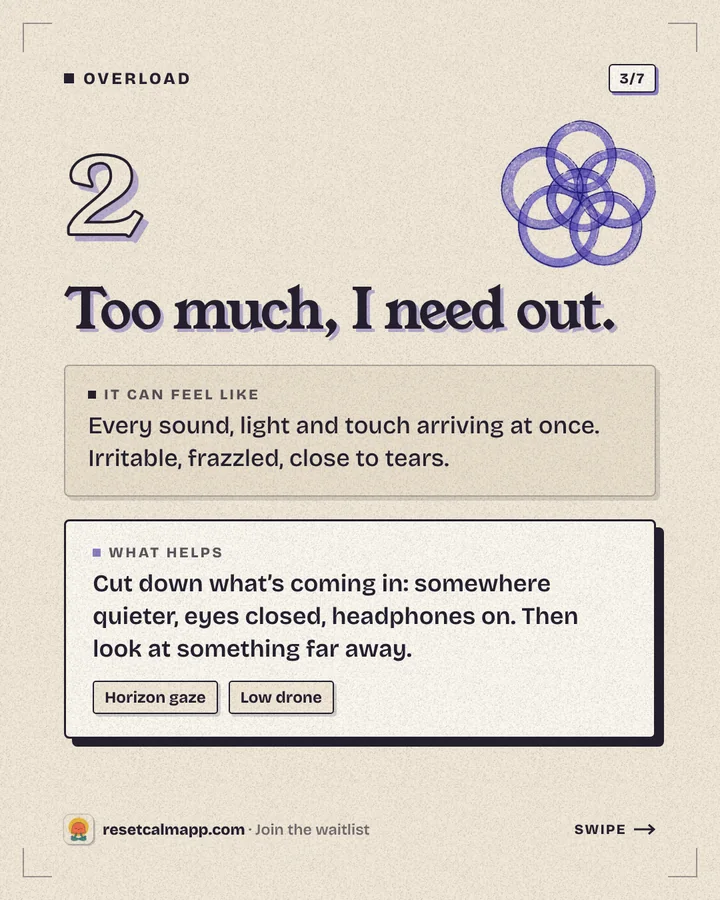
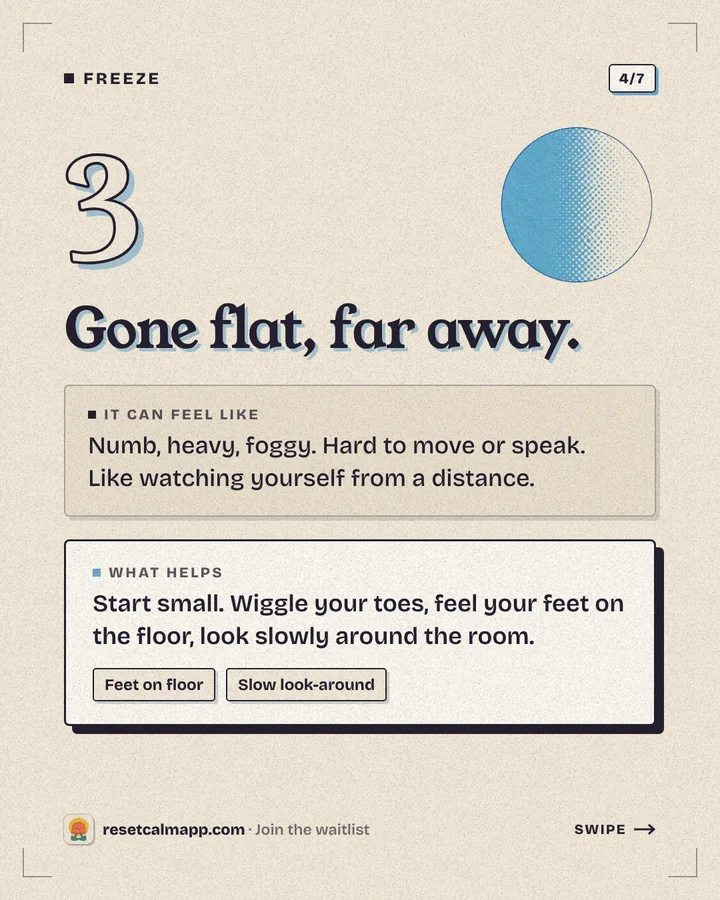
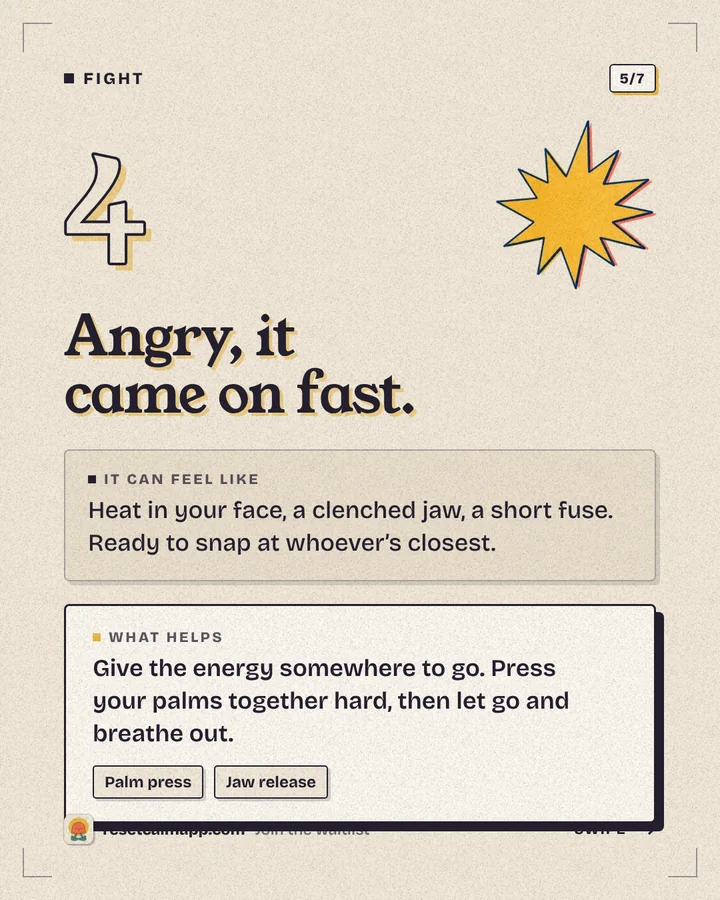
- Anxiety isn't one feeling. Your body's alarm has four settings: heart racing, can't breathe. Too much, I need out. Gone flat, far away. Angry, it came on fast. Here's how to tell which one you're in, and what helps each.
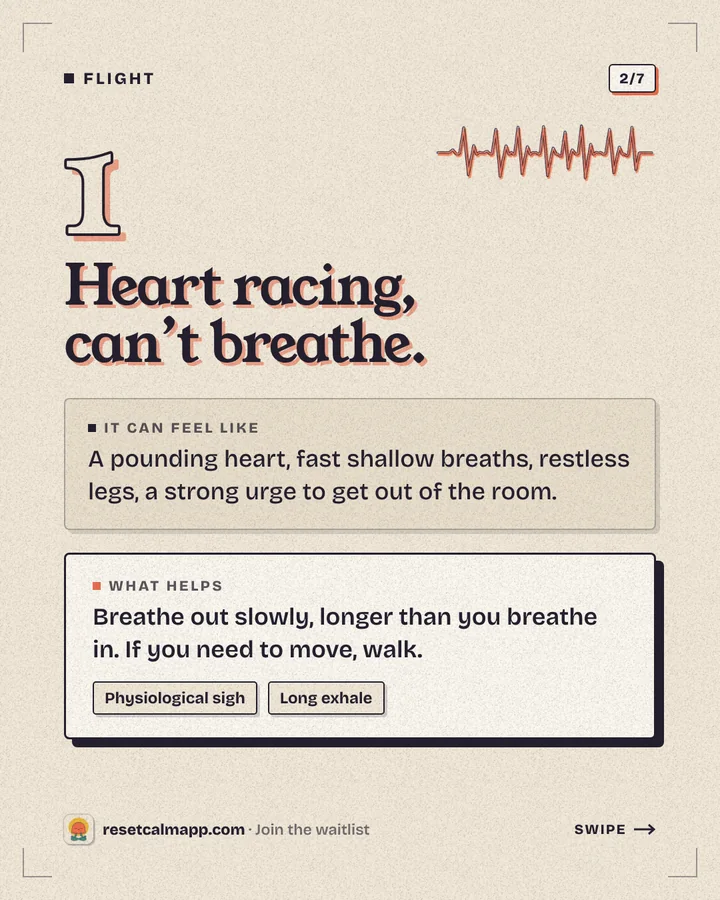
- 1, flight: heart racing, can't breathe. It can feel like a pounding heart, fast shallow breaths, restless legs, and a strong urge to get out of the room. What helps: breathe out slowly, longer than you breathe in. If you need to move, walk. Try a physiological sigh or a long exhale.
- 2, overload: too much, I need out. It can feel like every sound, light and touch arriving at once. Irritable, frazzled, close to tears. What helps: cut down what's coming in. Somewhere quieter, eyes closed, headphones on. Then look at something far away. Try a horizon gaze or a low drone.
- 3, freeze: gone flat, far away. It can feel numb, heavy and foggy. Hard to move or speak, like watching yourself from a distance. What helps: start small. Wiggle your toes, feel your feet on the floor, look slowly around the room. Try feet on floor or a slow look-around.
- 4, fight: angry, it came on fast. It can feel like heat in your face, a clenched jaw and a short fuse, ready to snap at whoever's closest. What helps: give the energy somewhere to go. Press your palms together hard, then let go and breathe out. Try a palm press or a jaw release.
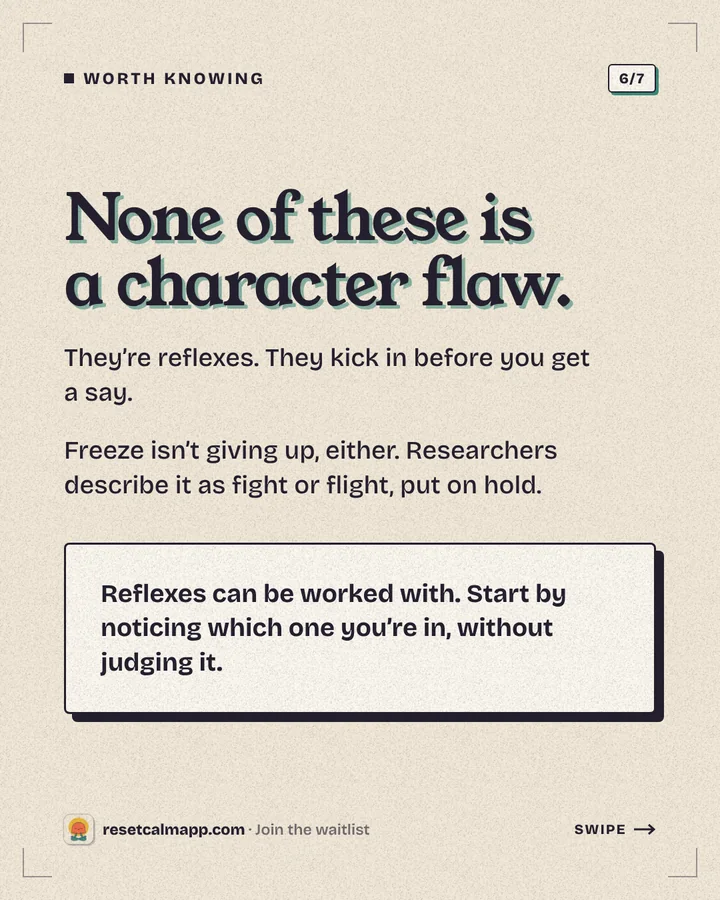
- None of these is a character flaw. They're reflexes, and they kick in before you get a say. Freeze isn't giving up, either. Researchers describe it as fight or flight, put on hold. Reflexes can be worked with. Start by noticing which one you're in, without judging it.
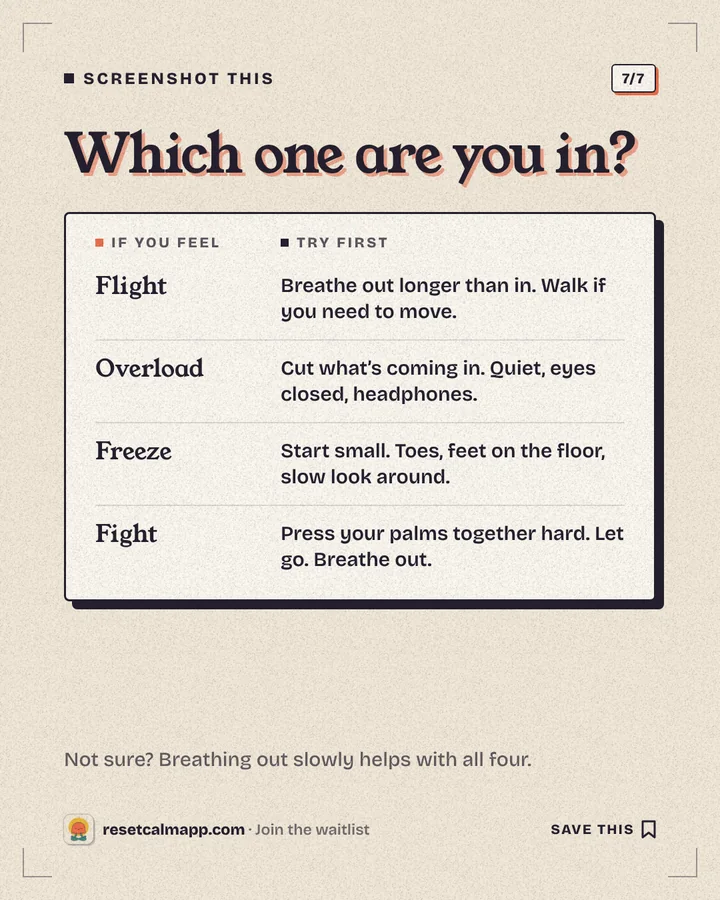
- Which one are you in? Flight: breathe out longer than in, and walk if you need to move. Overload: cut what's coming in, with quiet, eyes closed and headphones. Freeze: start small, with your toes, your feet on the floor and a slow look around. Fight: press your palms together hard, let go and breathe out. Not sure? Breathing out slowly helps with all four.
Freezing isn't giving up
One card, for anyone who went still and blamed themselves for it.
Read the cards as text
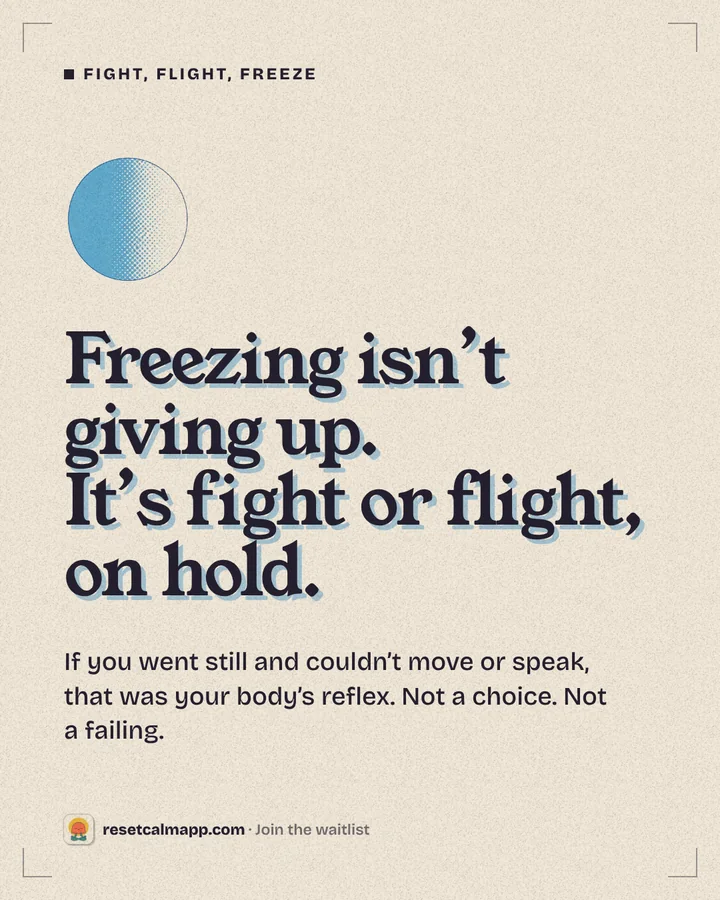
- Freezing isn't giving up. It's fight or flight, on hold. If you went still and couldn't move or speak, that was your body's reflex. Not a choice. Not a failing.
You're not overreacting. Your cup is full.
What overstimulated actually means, how to let some of it drain away, and how to help someone who's overstimulated.
Read the cards as text
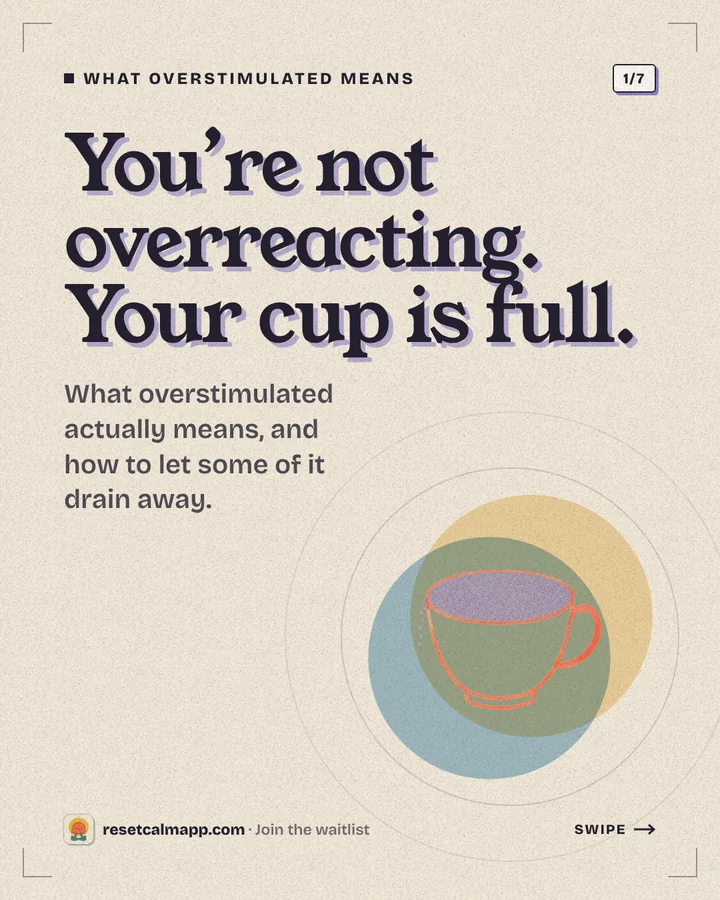
- You're not overreacting. Your cup is full. What overstimulated actually means, and how to let some of it drain away.
- Most of the day, your senses work quietly. You take in the light, the sounds, the feel of your clothes, and you don't notice most of it. Your brain tunes it out for you, so you can get on with things.
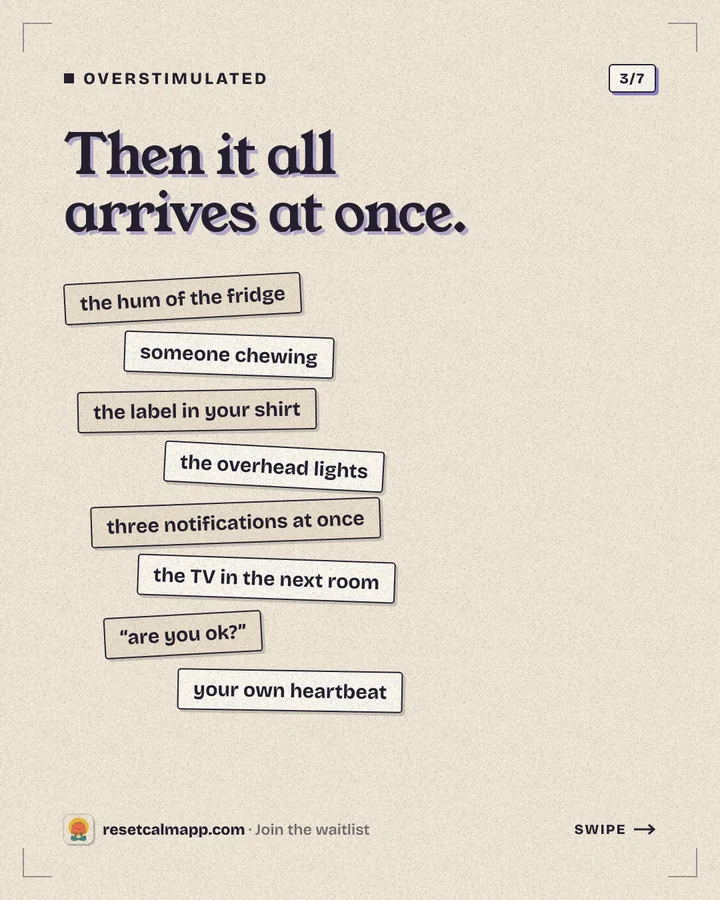
- Then it all arrives at once: the hum of the fridge, someone chewing, the label in your shirt, the overhead lights, three notifications at once, the TV in the next room, someone asking if you're ok, your own heartbeat.
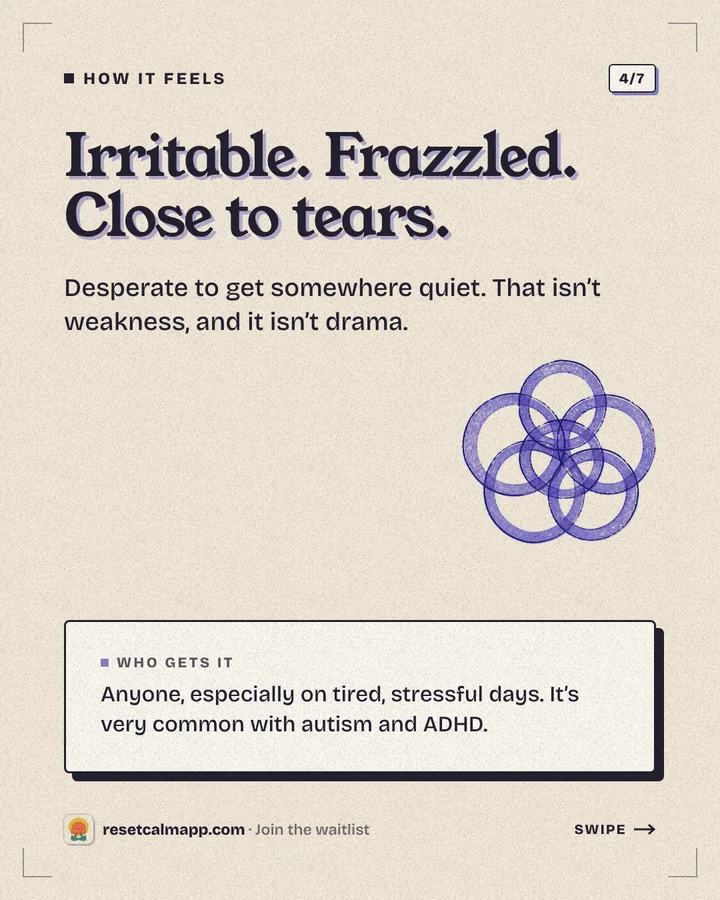
- Irritable. Frazzled. Close to tears. Desperate to get somewhere quiet. That isn't weakness, and it isn't drama. Anyone can get it, especially on tired, stressful days. It's very common with autism and ADHD.
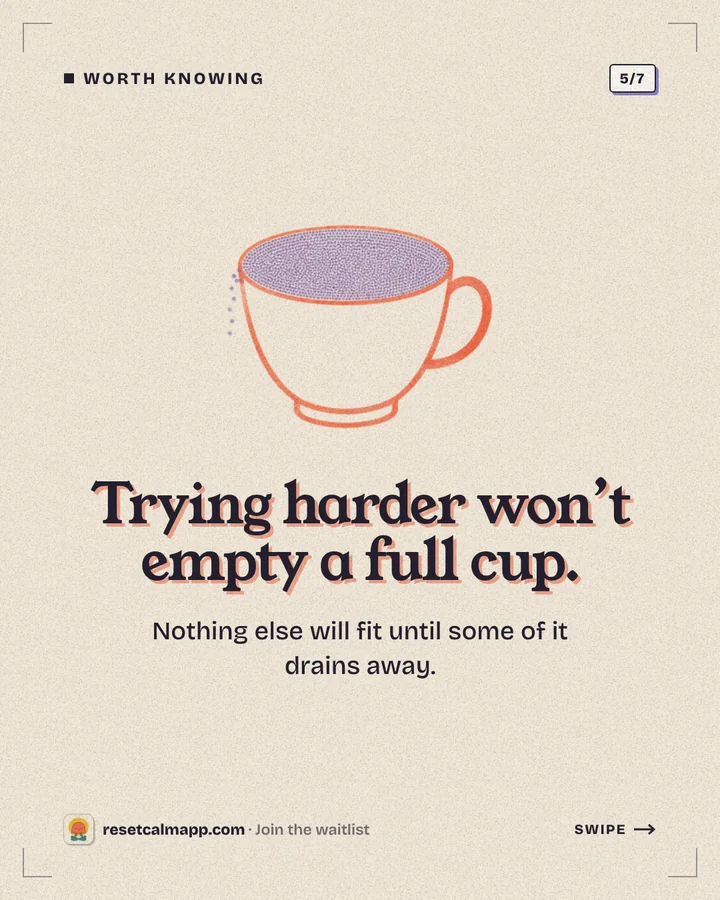
- Trying harder won't empty a full cup. Nothing else will fit until some of it drains away.
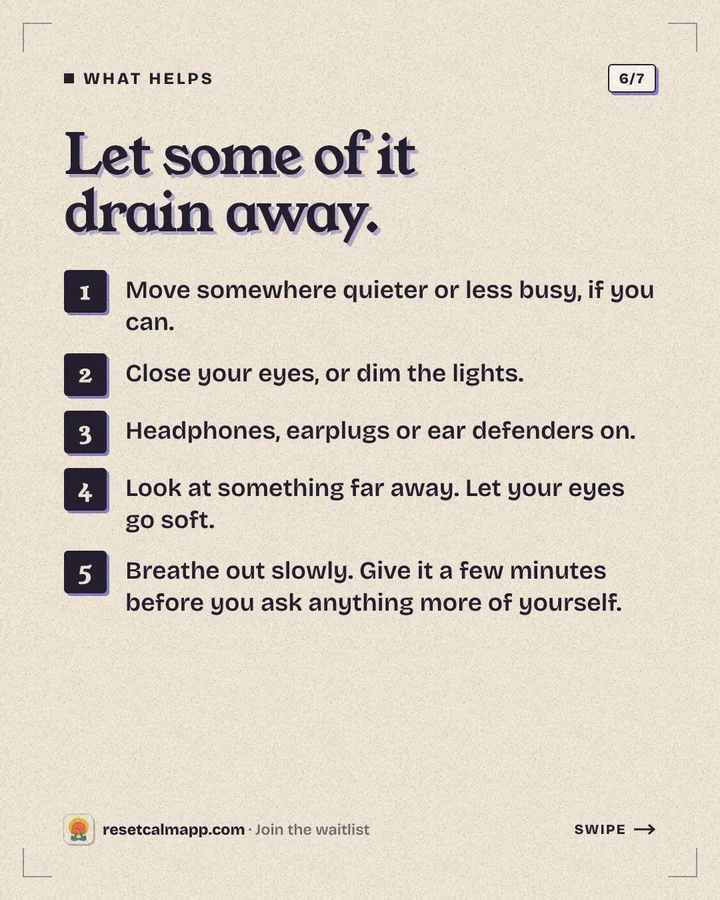
- Let some of it drain away. Move somewhere quieter or less busy, if you can. Close your eyes, or dim the lights. Put on headphones, earplugs or ear defenders. Look at something far away and let your eyes go soft. Breathe out slowly, and give it a few minutes before you ask anything more of yourself.
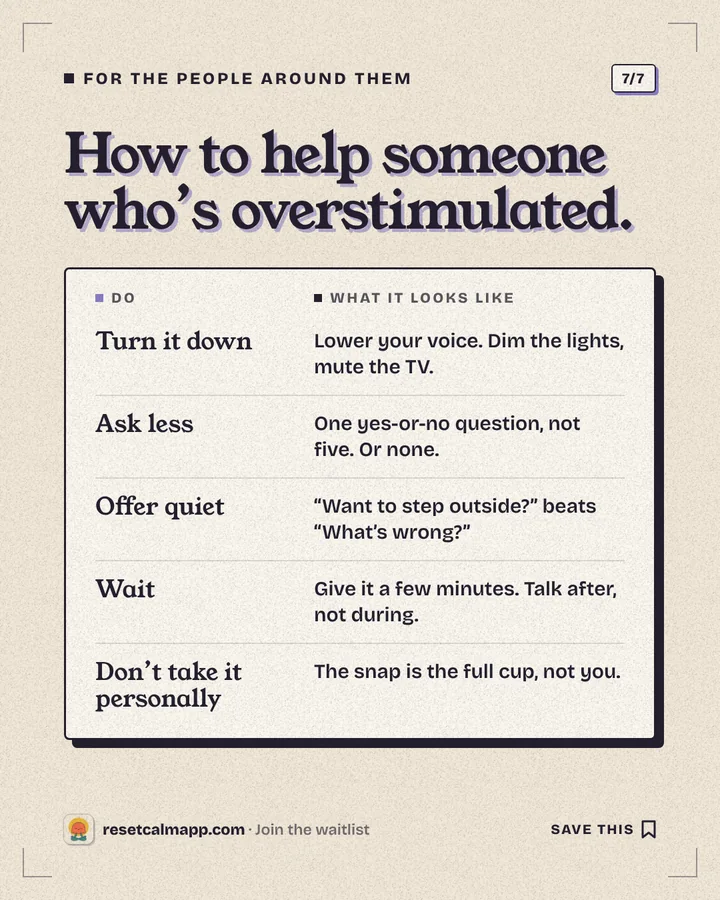
- How to help someone who's overstimulated. Turn it down: lower your voice, dim the lights, mute the TV. Ask less: one yes-or-no question, not five, or none. Offer quiet: asking if they want to step outside beats asking what's wrong. Wait: give it a few minutes, and talk after, not during. Don't take it personally: the snap is the full cup, not you.