What overstimulated actually means
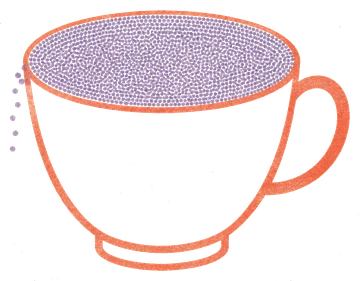
Being overstimulated means more sound, light, touch or activity is coming in than you can comfortably take in at once. Everything reaches you at the same time, and it can feel unbearable. It's common in autism and ADHD, and anyone can feel it on a tired, stressful day.
The short version, in cards
Read the cards as text
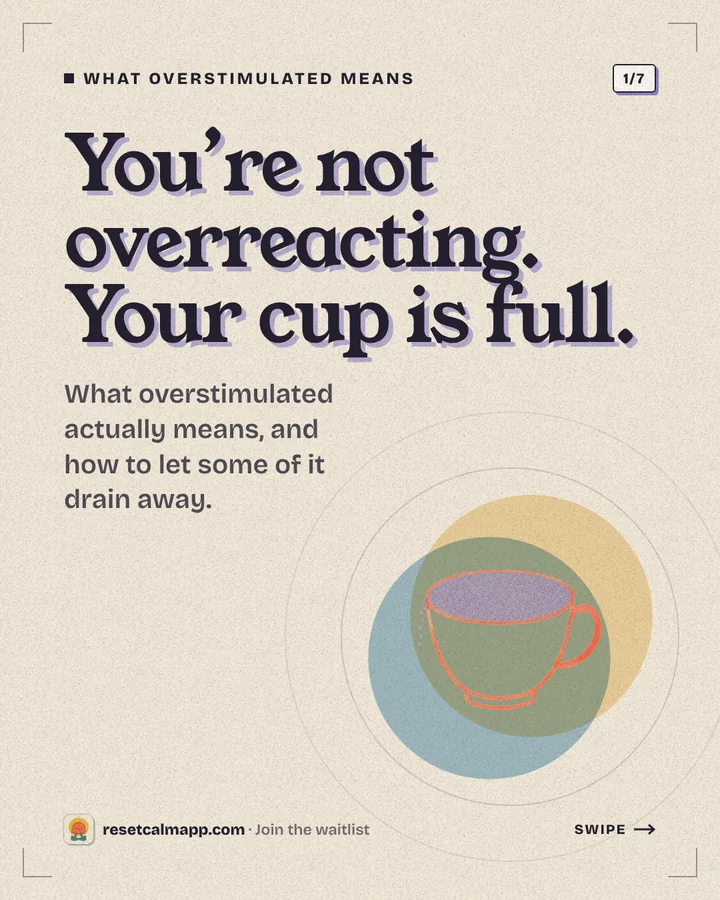
- You're not overreacting. Your cup is full. What overstimulated actually means, and how to let some of it drain away.
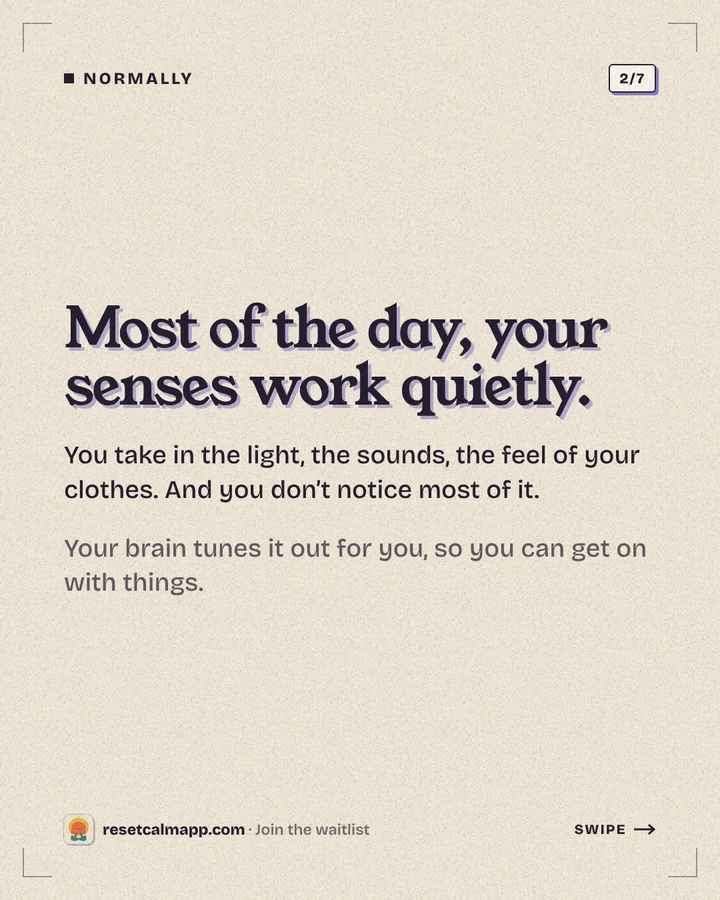
- Most of the day, your senses work quietly. You take in the light, the sounds, the feel of your clothes, and you don't notice most of it. Your brain tunes it out for you, so you can get on with things.
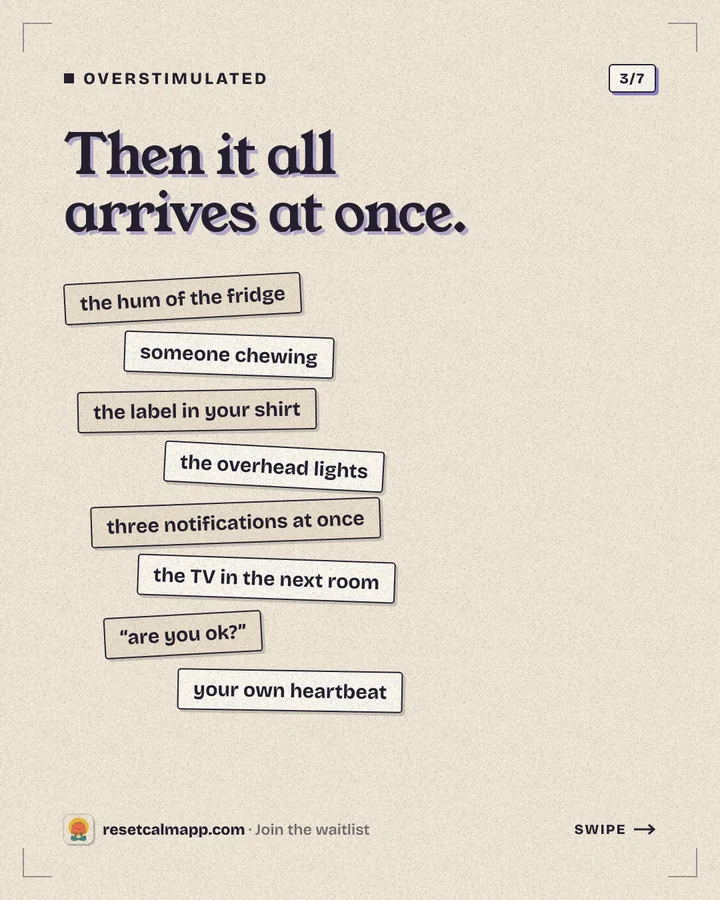
- Then it all arrives at once: the hum of the fridge, someone chewing, the label in your shirt, the overhead lights, three notifications at once, the TV in the next room, someone asking if you're ok, your own heartbeat.
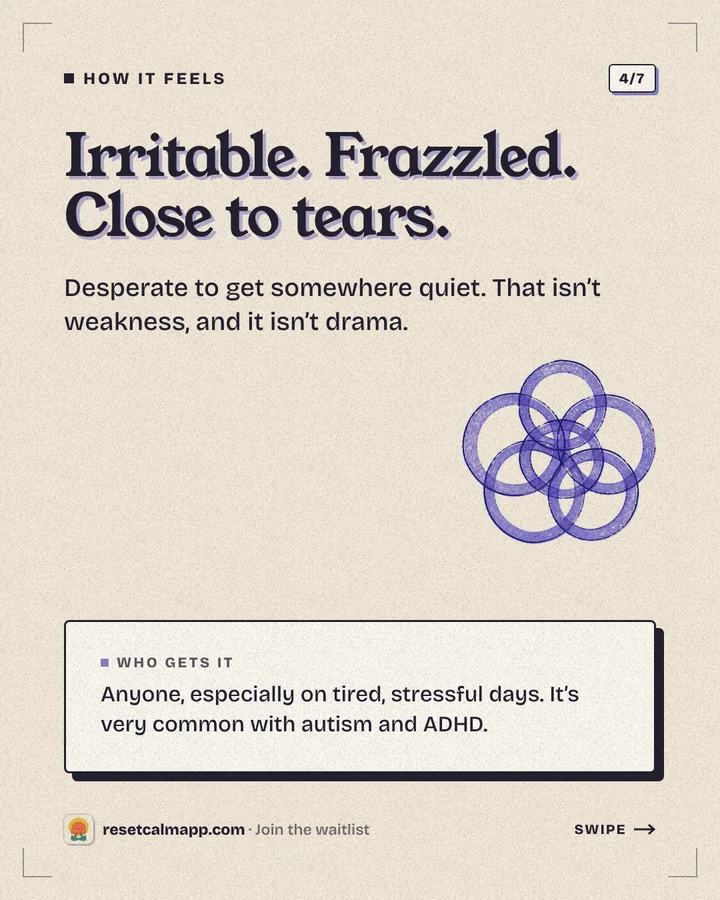
- Irritable. Frazzled. Close to tears. Desperate to get somewhere quiet. That isn't weakness, and it isn't drama. Anyone can get it, especially on tired, stressful days. It's very common with autism and ADHD.
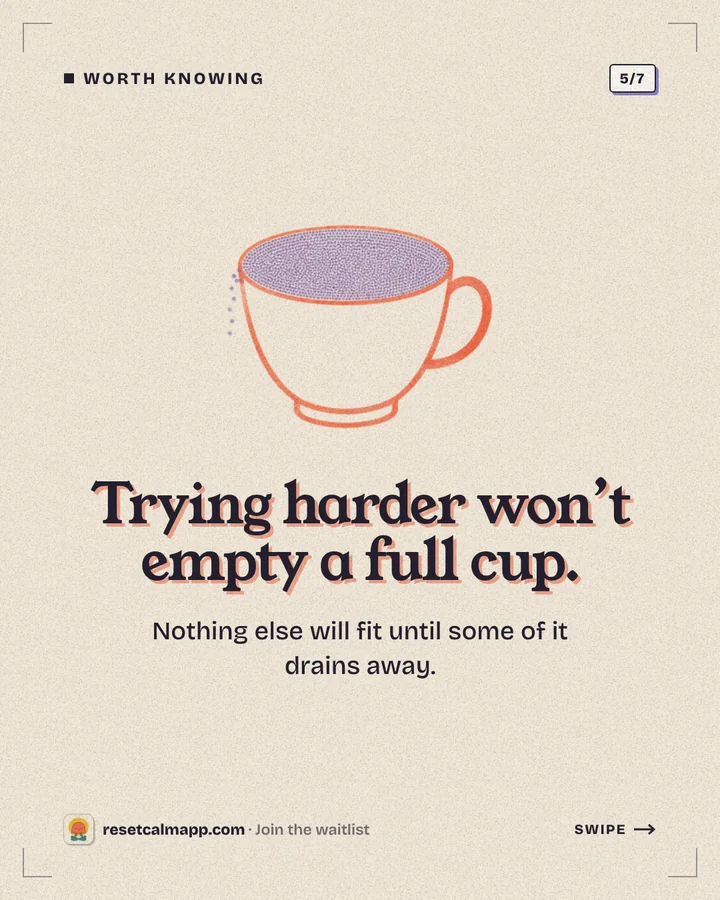
- Trying harder won't empty a full cup. Nothing else will fit until some of it drains away.
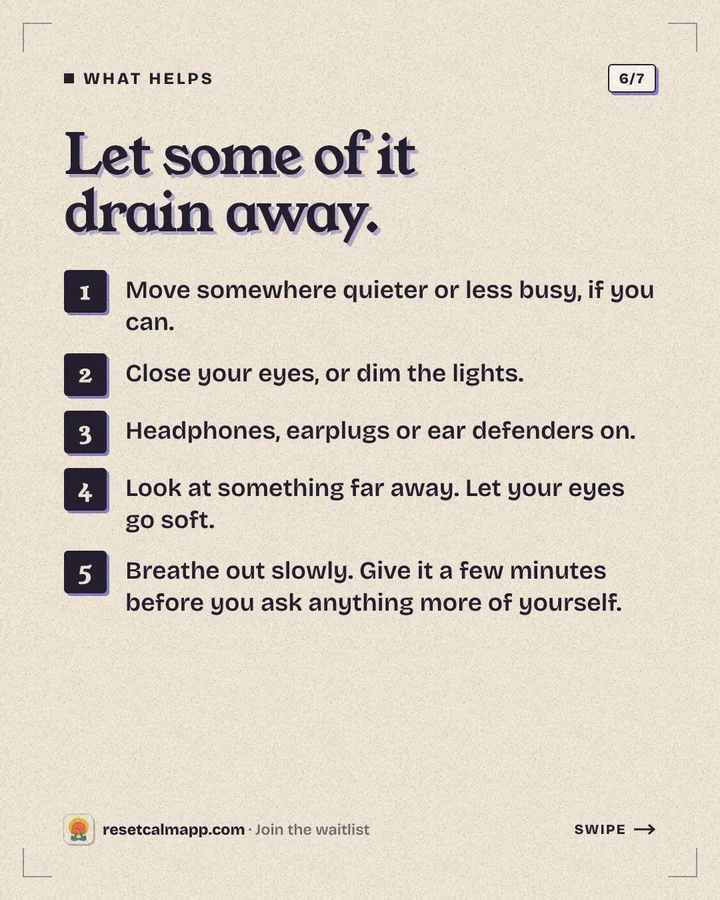
- Let some of it drain away. Move somewhere quieter or less busy, if you can. Close your eyes, or dim the lights. Put on headphones, earplugs or ear defenders. Look at something far away and let your eyes go soft. Breathe out slowly, and give it a few minutes before you ask anything more of yourself.
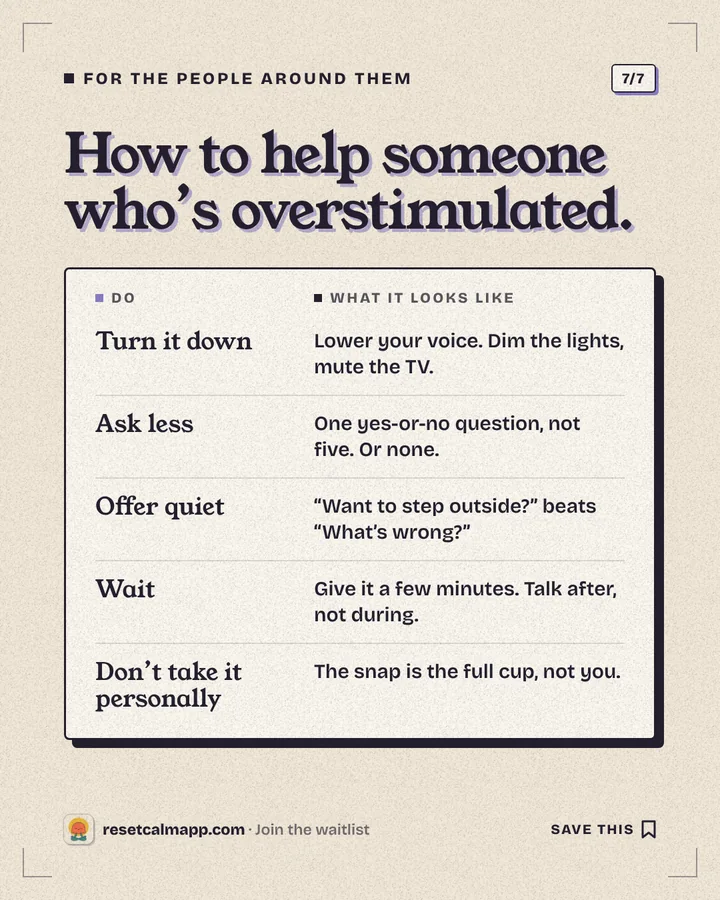
- How to help someone who's overstimulated. Turn it down: lower your voice, dim the lights, mute the TV. Ask less: one yes-or-no question, not five, or none. Offer quiet: asking if they want to step outside beats asking what's wrong. Wait: give it a few minutes, and talk after, not during. Don't take it personally: the snap is the full cup, not you.
What it means
Overstimulated isn't a medical term, so here's ours: more sound, light, touch or activity coming in than you can comfortably take in at once.
Health services use words like sensory differences, sensory sensitivities or sensory overload. The NHS describes some autistic adults as very sensitive to light, sounds, smells, tastes or textures1.
NICE, which writes guidance for the NHS, notes that being over-sensitive to sound, light, colour, smell or taste can cause anxiety or even pain in an autistic person2.
What it feels like
Most of the day your senses do their job quietly. You take in the light, the sounds and the feel of your clothes, and you don't notice most of it.
When you're overstimulated, the things you'd normally tune out all arrive at once: the hum of the fridge, someone chewing, the label in your shirt. You might feel irritable, frazzled, close to tears, or desperate to get somewhere quiet.
It isn't a sign that you're weak or dramatic. Think of it as a full cup. Nothing else will fit until some of it drains away, and trying harder won't change that.
Who gets it
Anyone can. In a study of healthy young adults, feeling flooded by sensations was one of the patterns people reported, and they said it got worse when they were tired or stressed3.
The NHS lists being very sensitive to light, sounds, smells, tastes or textures as one of the signs of autism in adults1. Adults with ADHD also report more sensitivity to sensations than most people4.
What helps
Planning ahead helps too. For autistic adults, NICE suggests adjusting the space itself, for example with less harsh lighting and fewer outside sounds2.
Try it
 Physiological sigh45 s · in, a second sip in, a long breath out
 Pursed-lip breath45 s · in 2 · out through pursed lips 4
 Legs up the wall120 s · lie back, legs up, stay
Questions
What's the difference between overstimulated and overwhelmed?
They overlap. Overstimulated is about your senses: too much coming in. Overwhelmed is broader, and can be about too many demands or feelings. Overstimulation is one common way to end up overwhelmed.
Is overstimulation an ADHD thing?
It's common in ADHD, and adults with ADHD report more sensitivity to sensations than most people4. It's common in autism too, and people say it gets worse when they're tired or stressed3.
What should I do when I'm overstimulated?
Cut down what's coming in: somewhere quieter, the lights down, eyes closed or headphones on5. Then breathe out slowly.
Read next
 Fight, flight, freeze, fawn: your body's responses to threatLearn · 3 min read
 How to calm anxiety fast: five things you can start in under a minuteBlog · 3 min read
 What a panic attack is, and what it feels likeLearn · 3 min read
- NHS. Signs of autism in adults. https://www.nhs.uk/conditions/autism/signs-in-adults/ (accessed 30 September 2026)
- NICE. Autism spectrum disorder in adults: diagnosis and management (CG142). https://www.nice.org.uk/guidance/cg142/chapter/Recommendations (accessed 30 September 2026)
- Hetrick WP, Erickson MA, Smith DA. Phenomenological dimensions of sensory gating. Schizophrenia Bulletin, 2012. https://pmc.ncbi.nlm.nih.gov/articles/PMC3245584/ (accessed 30 September 2026)
- Bijlenga D, et al. Atypical sensory profiles as core features of adult ADHD, irrespective of autistic symptoms. European Psychiatry, 2017. https://doi.org/10.1016/j.eurpsy.2017.02.481 (accessed 30 September 2026)
- NHS inform. Panic self-help guide. https://www.nhsinform.scot/illnesses-and-conditions/mental-health/mental-health-self-help-guides/panic-self-help-guide/ (accessed 30 September 2026)