Fight, flight, freeze, fawn: your body's responses to threat

Fight, flight and freeze are your body's built-in responses to threat, and they kick in before you get a say. Fight and flight get you ready to act. Freeze holds you still, alert and ready. Fawn, going along to keep the peace, is a newer idea that hasn't been studied in the same way.
The short version, in cards
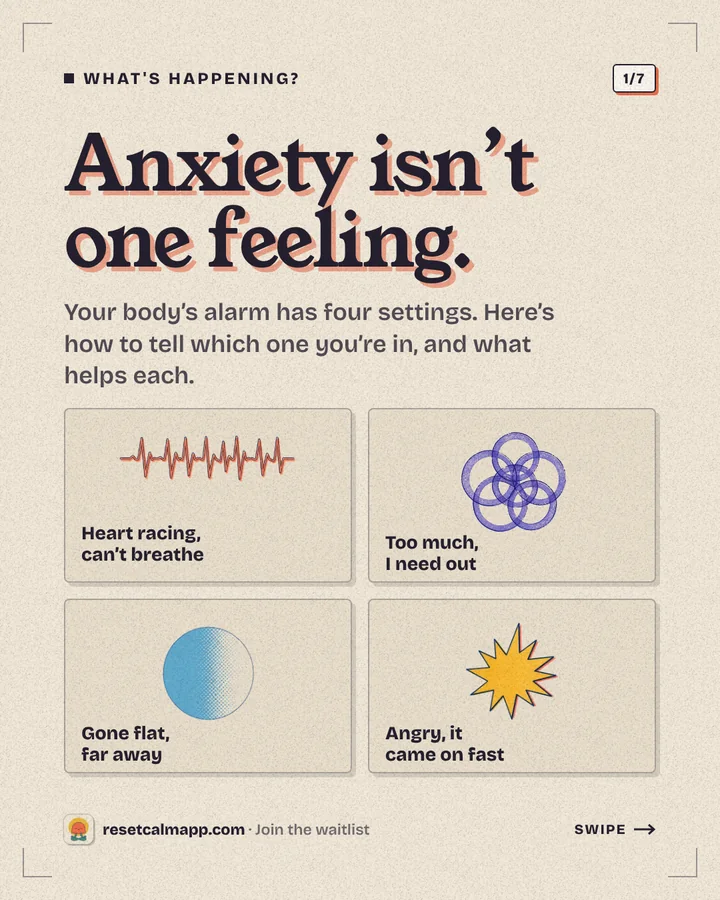
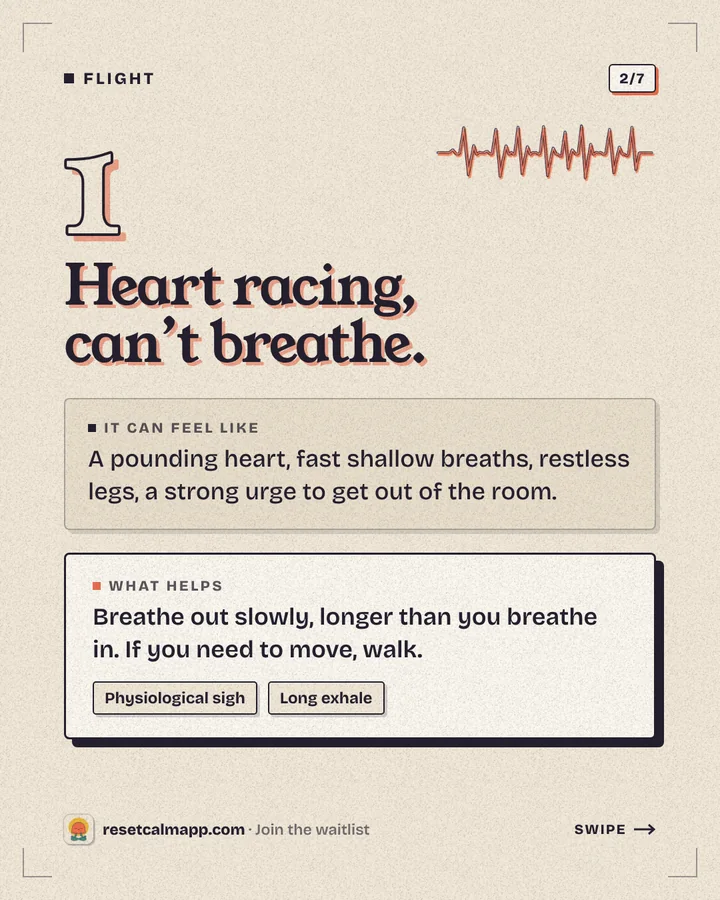
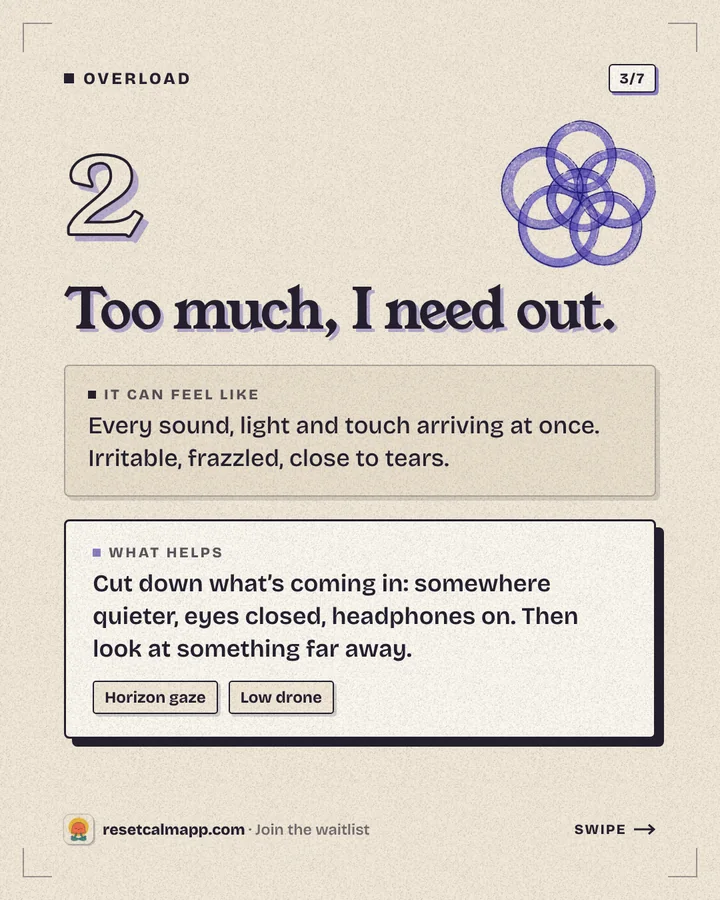
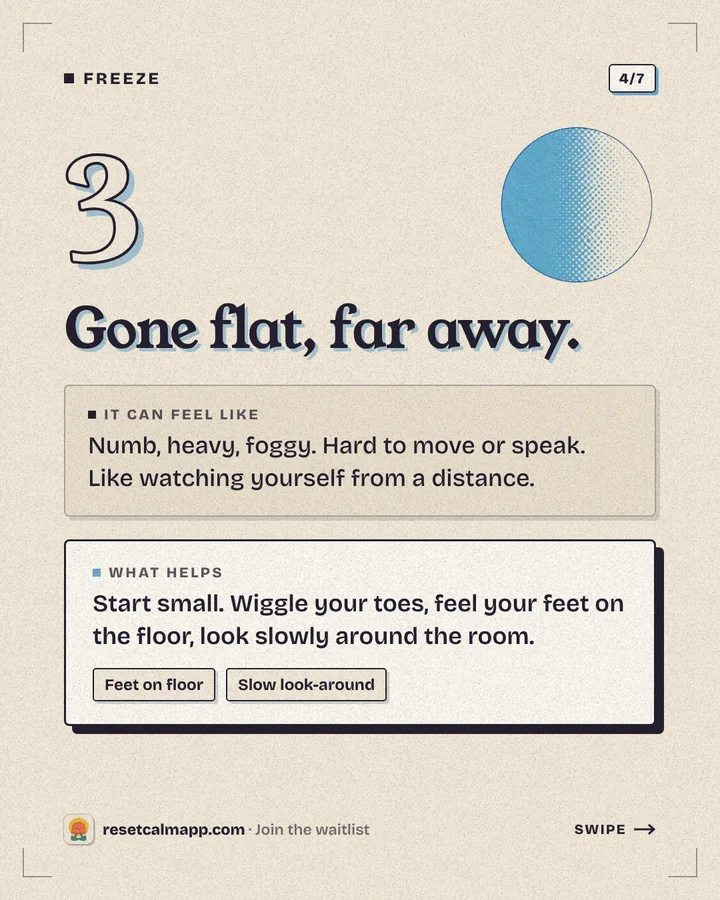
Read the cards as text
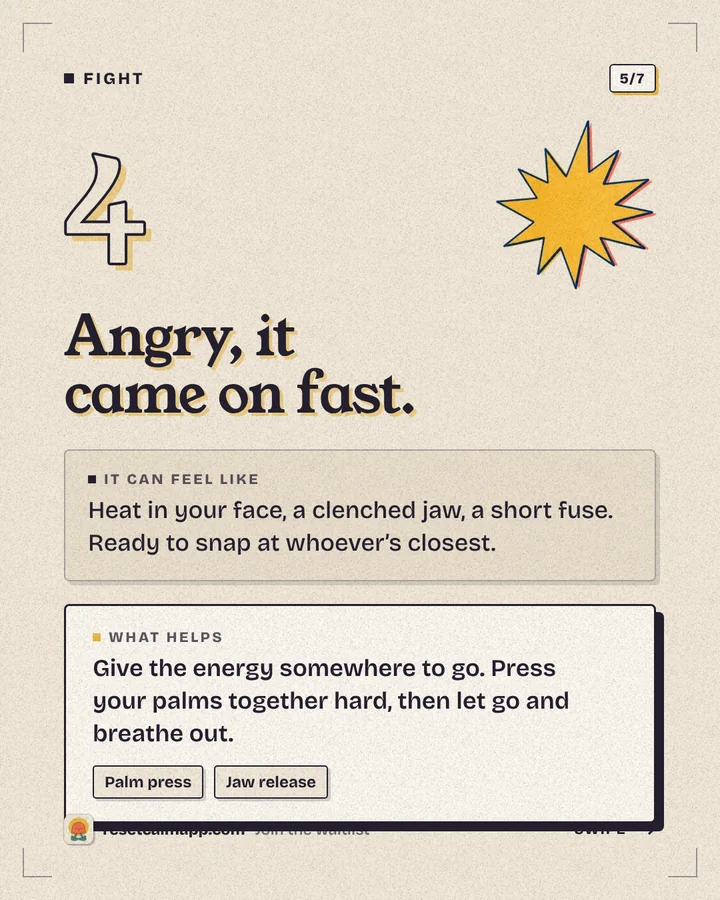
- Anxiety isn't one feeling. Your body's alarm has four settings: heart racing, can't breathe. Too much, I need out. Gone flat, far away. Angry, it came on fast. Here's how to tell which one you're in, and what helps each.
- 1, flight: heart racing, can't breathe. It can feel like a pounding heart, fast shallow breaths, restless legs, and a strong urge to get out of the room. What helps: breathe out slowly, longer than you breathe in. If you need to move, walk. Try a physiological sigh or a long exhale.
- 2, overload: too much, I need out. It can feel like every sound, light and touch arriving at once. Irritable, frazzled, close to tears. What helps: cut down what's coming in. Somewhere quieter, eyes closed, headphones on. Then look at something far away. Try a horizon gaze or a low drone.
- 3, freeze: gone flat, far away. It can feel numb, heavy and foggy. Hard to move or speak, like watching yourself from a distance. What helps: start small. Wiggle your toes, feel your feet on the floor, look slowly around the room. Try feet on floor or a slow look-around.
- 4, fight: angry, it came on fast. It can feel like heat in your face, a clenched jaw and a short fuse, ready to snap at whoever's closest. What helps: give the energy somewhere to go. Press your palms together hard, then let go and breathe out. Try a palm press or a jaw release.
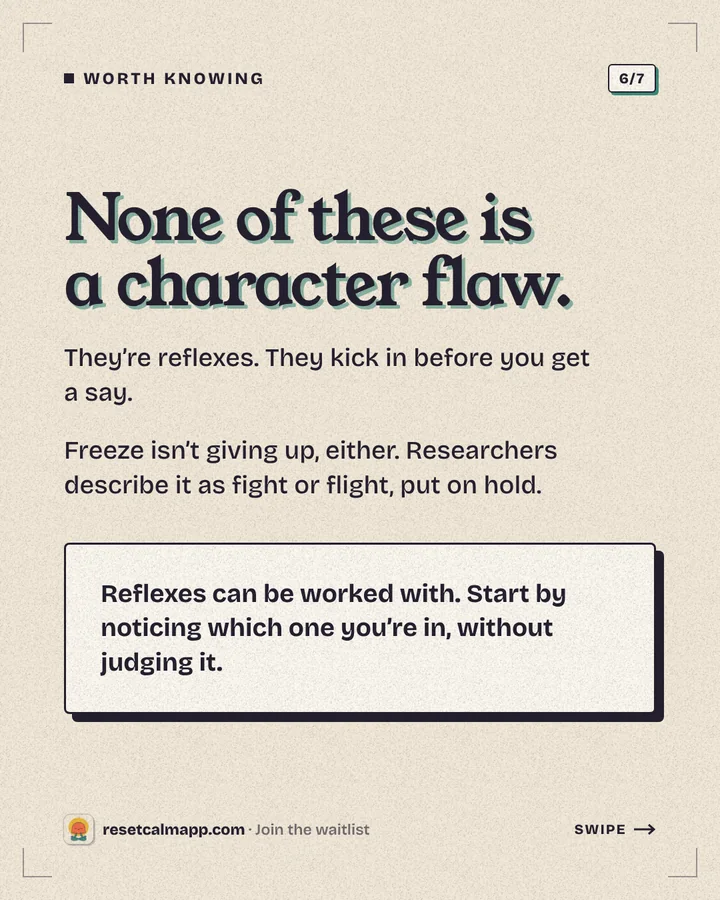
- None of these is a character flaw. They're reflexes, and they kick in before you get a say. Freeze isn't giving up, either. Researchers describe it as fight or flight, put on hold. Reflexes can be worked with. Start by noticing which one you're in, without judging it.
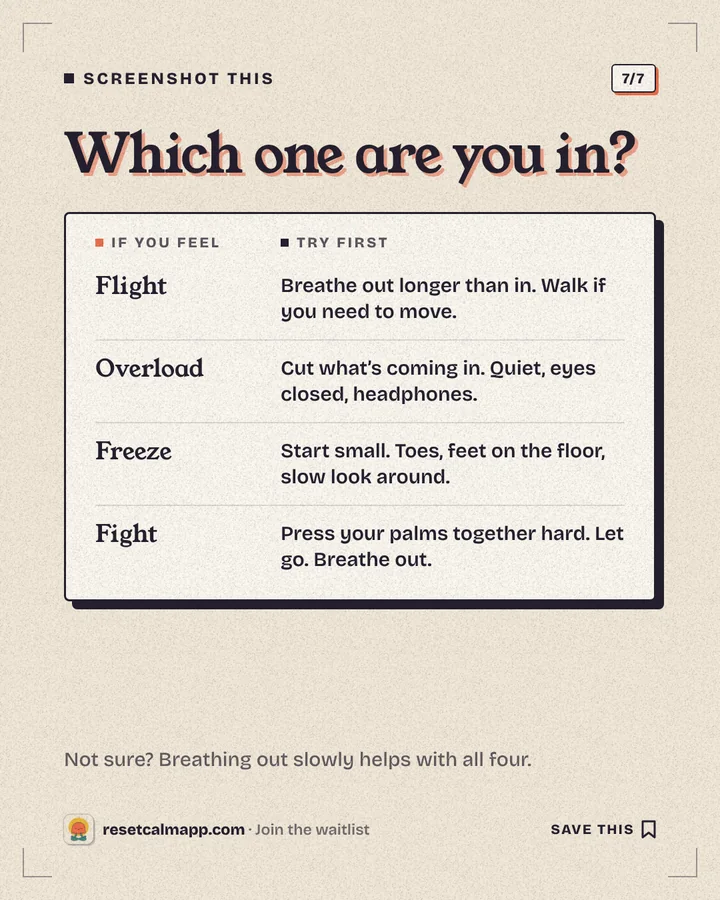
- Which one are you in? Flight: breathe out longer than in, and walk if you need to move. Overload: cut what's coming in, with quiet, eyes closed and headphones. Freeze: start small, with your toes, your feet on the floor and a slow look around. Fight: press your palms together hard, let go and breathe out. Not sure? Breathing out slowly helps with all four.
Read the cards as text
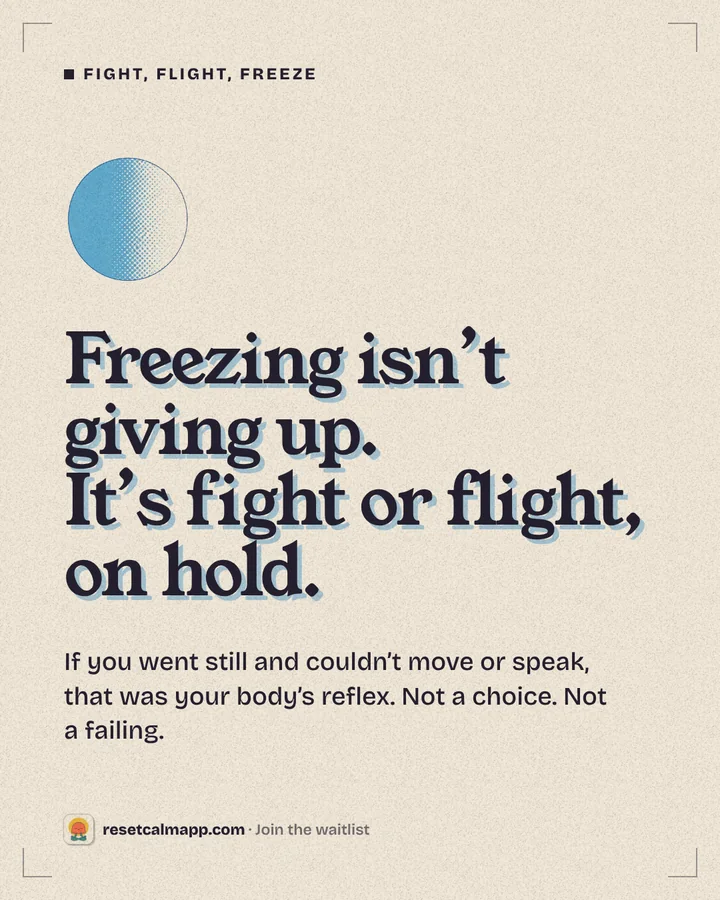
- Freezing isn't giving up. It's fight or flight, on hold. If you went still and couldn't move or speak, that was your body's reflex. Not a choice. Not a failing.
Your body's alarm
When your brain senses a threat, it releases chemicals, including adrenaline, that have strong and immediate effects on your body. NHS inform describes three reactions to fear: fight, flight or freeze1.
The idea of fight or flight goes back more than a century, to the physiologist Walter Cannon2.
Fight and flight
Fight and flight are active. Your muscles tense so you're ready to fight or run away, which can leave you tense, achy or trembling1.
Fight can feel like heat, a clenched jaw and a short fuse. Flight can feel like restless legs and a strong urge to leave the room.
Freeze
Freeze is often misunderstood. It isn't giving up. Freezing is a universal fear response, and it actively prepares the body for what comes next3. Researchers describe it as fight or flight put on hold2.
When a threat feels inescapable, some people go completely still and can't move. It's called tonic immobility, and it's common: in one study of women seen after a sexual assault, 70% reported it4.
If you froze and didn't fight back, that was very likely your body's reflex. It wasn't a choice, and it isn't a failing.
Fawn
Some therapists add a fourth response, fawn: going soft and agreeable, people-pleasing, to stay safe. It's a useful word for a real pattern, but it comes from a therapist's book rather than research, and even papers that use it say it's understudied5.
What helps
None of these is a character flaw. They're reflexes, and reflexes can be worked with.
- Notice which one you're in, without judging it.
- Fight or flight: move if it helps. Walk, or press your palms together.
- Freeze: start small. Wiggle your toes, feel your feet on the floor, and look slowly around the room.
- Any of them: breathe out slowly, longer than you breathe in1.
What about shaking it off?
You may read that animals shake off a fright, and that shaking releases stress. It's a popular idea, but there's little research on it. Even the therapists behind it write that shaking and trembling are very little referred to in the literature6.
Trembling during or after a fright is a normal part of the fear response, and it passes1.
When to get help. If you've been raped or sexually assaulted, you don't have to deal with it alone, however long ago it was. The NHS explains where to get help7.
Try it
 Butterfly hug60 s · left, right, slowly
 5-4-3-2-190 s · five things, then four, then three
 Physiological sigh45 s · in, a second sip in, a long breath out
Questions
What does fawn mean?
Going along with others, people-pleasing or appeasing, to keep yourself safe. It's a term from therapy rather than an established stress response, and even papers that use it say it's understudied5.
Why did I freeze instead of fighting back?
Freezing is a universal fear response3, and under extreme threat many people can't move at all4. It's a reflex, not a decision.
Is fight or flight the same as a panic attack?
A panic attack uses the same alarm system, set off when there's no danger. The adrenaline that gets you ready to fight or run is what sets off the racing heart1.
How do I get out of freeze?
Start with small movements and your senses: wiggle your toes, feel the floor, look around the room, and breathe out slowly1.
Read next
 What a panic attack is, and what it feels likeLearn · 3 min read
 What overstimulated actually meansLearn · 2 min read
 How to get through a panic attack in public, without anyone noticingBlog · 3 min read
- NHS inform. Panic self-help guide. https://www.nhsinform.scot/illnesses-and-conditions/mental-health/mental-health-self-help-guides/panic-self-help-guide/ (accessed 30 September 2026)
- Kozlowska K, Walker P, McLean L, Carrive P. Fear and the defense cascade: clinical implications and management. Harvard Review of Psychiatry, 2015. https://pmc.ncbi.nlm.nih.gov/articles/PMC4495877/ (accessed 30 September 2026)
- Roelofs K. Freeze for action: neurobiological mechanisms in animal and human freezing. Philosophical Transactions of the Royal Society B, 2017. https://pmc.ncbi.nlm.nih.gov/articles/PMC5332864/ (accessed 30 September 2026)
- Möller A, Söndergaard HP, Helström L. Tonic immobility during sexual assault: a common reaction predicting post-traumatic stress disorder and severe depression. Acta Obstetricia et Gynecologica Scandinavica, 2017. https://doi.org/10.1111/aogs.13174 (accessed 30 September 2026)
- Algarin AB, Lee JY, Zhan X. Fight, flight, fawn, freeze: rethinking substance use through a stress response lens. Current Addiction Reports, 2026. https://pmc.ncbi.nlm.nih.gov/articles/PMC12960391/ (accessed 30 September 2026)
- Payne P, Levine PA, Crane-Godreau MA. Somatic Experiencing: using interoception and proprioception as core elements of trauma therapy. Frontiers in Psychology, 2015. https://pmc.ncbi.nlm.nih.gov/articles/PMC4316402/ (accessed 30 September 2026)
- NHS. Help after rape and sexual assault. https://www.nhs.uk/live-well/sexual-health/help-after-rape-and-sexual-assault/ (accessed 30 September 2026)