What a panic attack is, and what it feels like
A panic attack is your body's alarm going off when there's no danger: a racing heart, fast breathing, tingling hands and a rush of fear. It's frightening, but it isn't dangerous, and most last between 5 and 20 minutes. Naming it plainly and breathing out slowly are good first things to do.
The short version, in cards
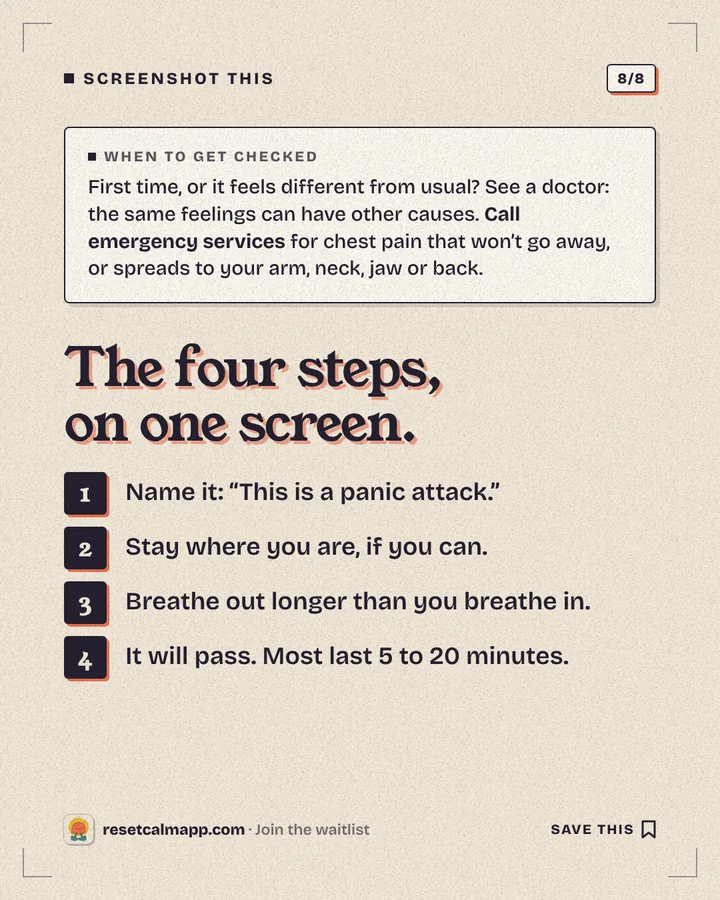
Read the cards as text
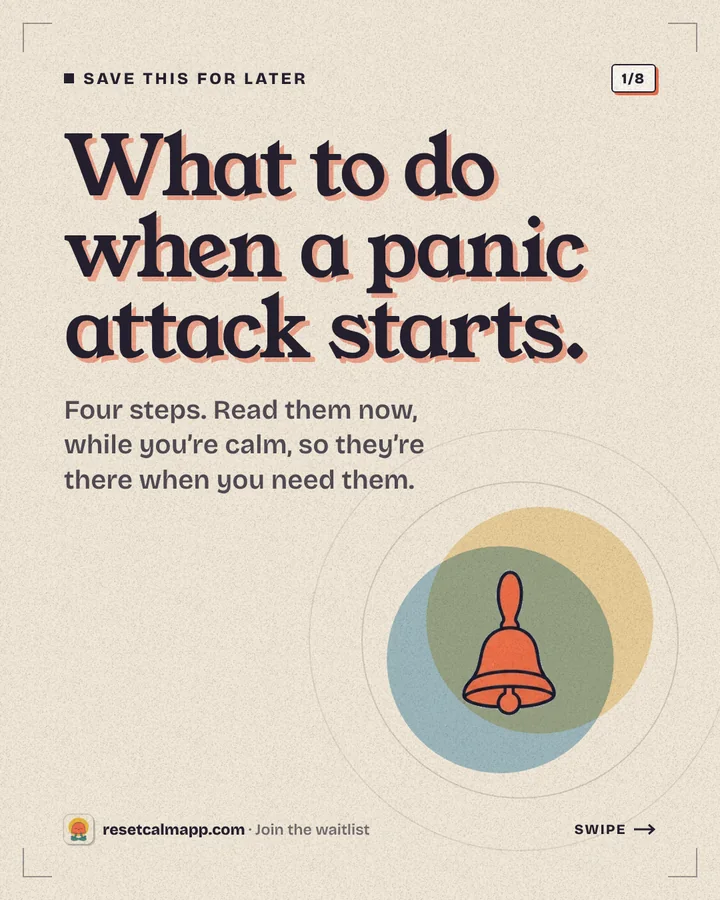
- What to do when a panic attack starts. Four steps. Read them now, while you're calm, so they're there when you need them.
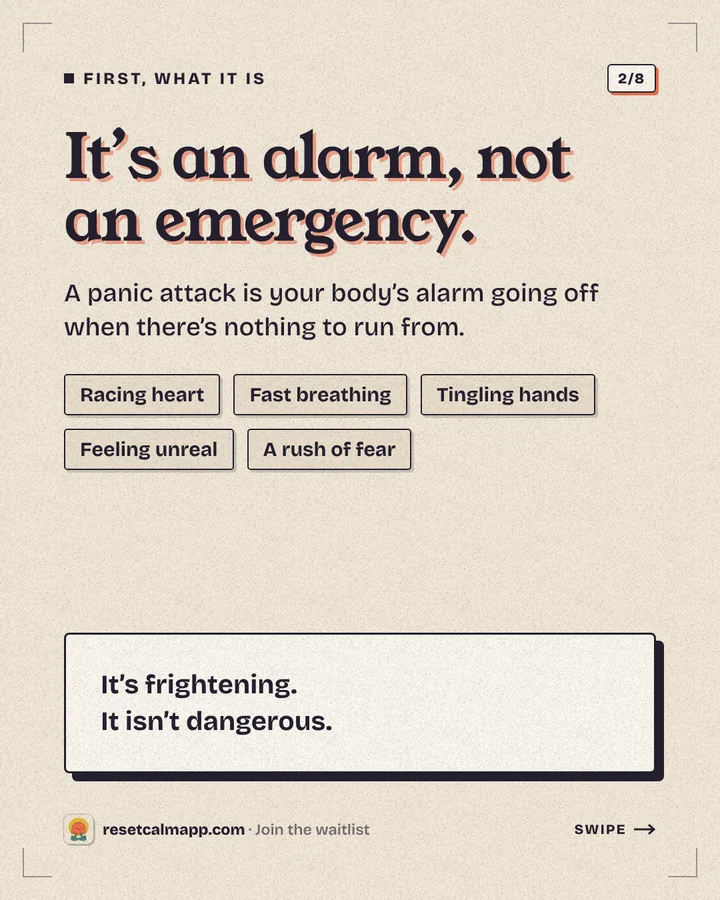
- It's an alarm, not an emergency. A panic attack is your body's alarm going off when there's nothing to run from: a racing heart, fast breathing, tingling hands, feeling unreal, a rush of fear. It's frightening. It isn't dangerous.
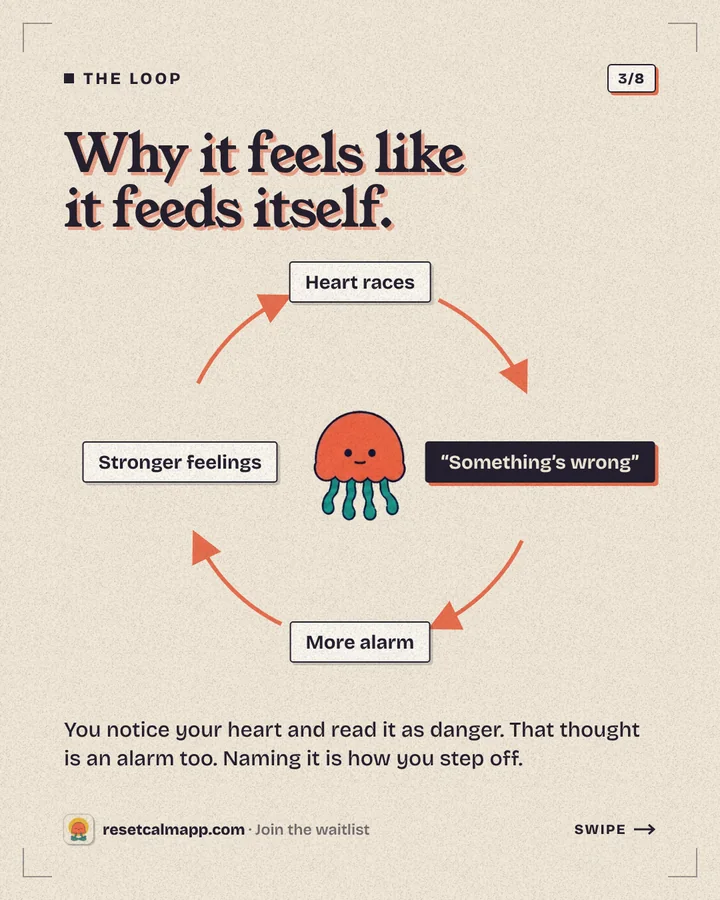
- Why it feels like it feeds itself. Your heart races, you think something's wrong, that sets off more alarm, and the feelings get stronger. You notice your heart and read it as danger. That thought is an alarm too. Naming it is how you step off.
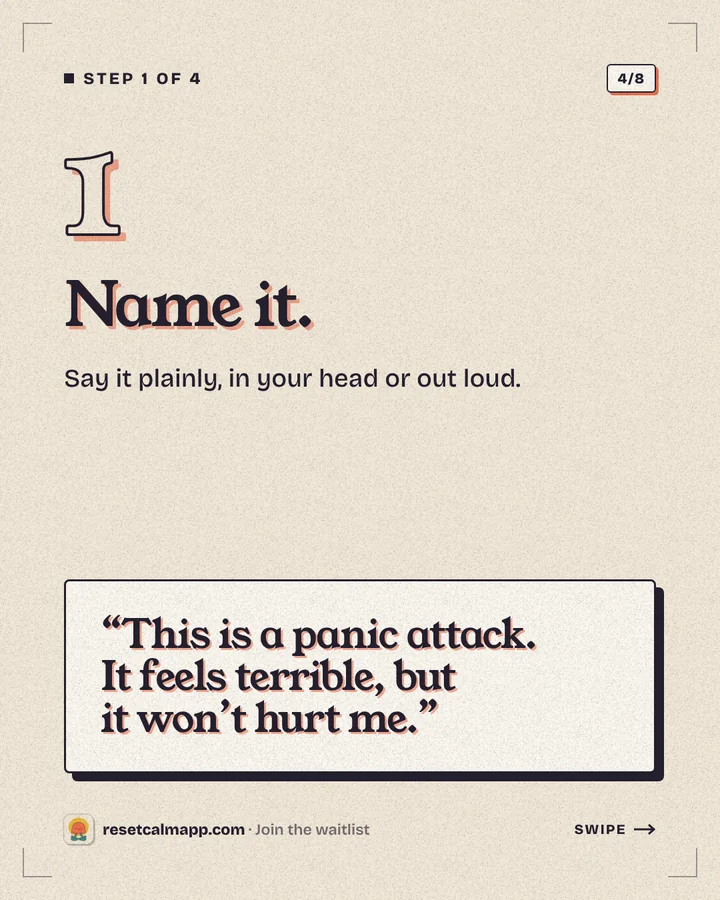
- Step 1 of 4: name it. Say it plainly, in your head or out loud: this is a panic attack. It feels terrible, but it won't hurt me.
- Step 2 of 4: stay where you are, if you can. You don't have to get anywhere or fix anything. Let it rise and fall right here.
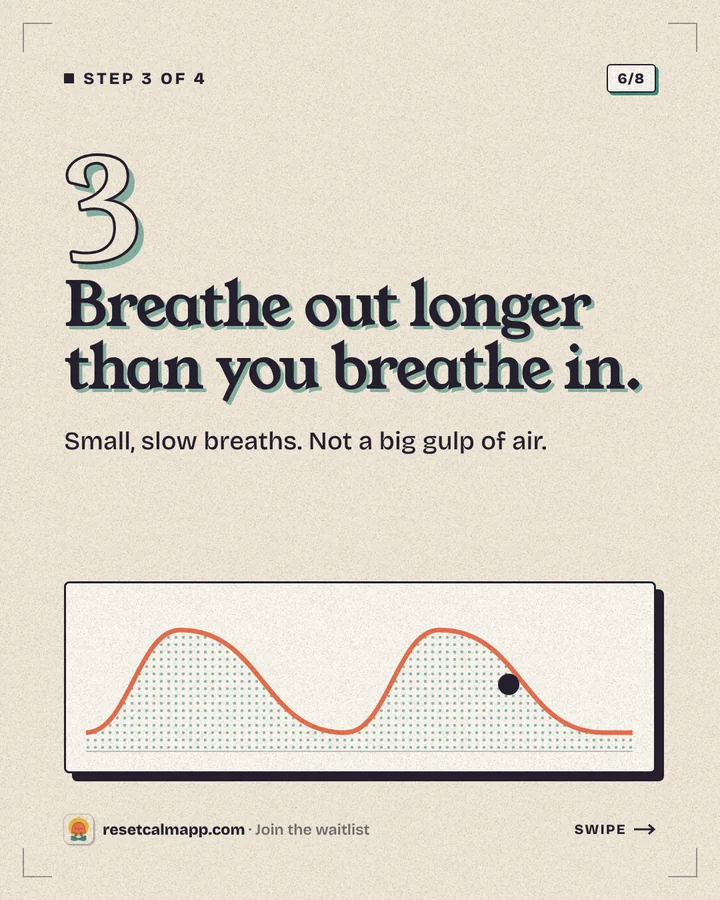
- Step 3 of 4: breathe out longer than you breathe in. Small, slow breaths. Not a big gulp of air.
- Step 4 of 4: remind yourself it will pass. Most panic attacks last between 5 and 20 minutes. The peak doesn't stay.
- When to get checked: if it's the first time, or it feels different from usual, see a doctor, because the same feelings can have other causes. Call emergency services for chest pain that won't go away, or that spreads to your arm, neck, jaw or back. The four steps on one screen: name it, this is a panic attack. Stay where you are, if you can. Breathe out longer than you breathe in. It will pass: most last 5 to 20 minutes.
What it feels like
A panic attack comes on fast. Common signs include a racing heartbeat, chest pain, feeling short of breath, trembling, tingling fingers, and feeling like you're not connected to your body1.
Many people feel sure that something terrible is happening: a heart attack, fainting, losing control. That certainty is part of the attack, not a sign of danger. Panic attacks are frightening, but they're not dangerous1.
They're also common. In surveys across many countries, about 13 in every 100 people had had at least one in their life2.
What's happening in your body
When you're anxious or scared, your body releases stress hormones such as adrenaline and cortisol. They can raise your heart rate and make you sweat, and in some people they set off a panic attack3.
It's the same system that would help you run from real danger. In a panic attack, it goes off when there's nothing to run from.
Why it can feel like it feeds itself
It can turn into a loop. You notice your heart racing and read it as a sign that something is wrong. That thought is an alarm too, so your anxiety rises, and the feelings get stronger4.
This is a leading explanation of panic. A review of the research found that misreading body sensations as a catastrophe is a distinctive part of panic disorder5. Researchers are still working out how much it causes panic in the first place.
Fear of the next attack can keep the loop going between attacks. The NHS calls it living in fear of fear1.
What to do when it starts
When to get help. Panic symptoms can also be signs of other conditions1. If it's the first time, or it feels different from your usual attacks, get checked by a GP. Call 999 if you have sudden chest pain that does not go away, pain that spreads to your arm, neck, jaw, stomach or back, or chest pain with sweating, feeling sick, light-headed or short of breath6.
Try it
 Physiological sigh45 s · in, a second sip in, a long breath out
 5-4-3-2-190 s · five things, then four, then three
 Box breathing64 s · in 4 · hold 4 · out 4 · hold 4
Questions
Can a panic attack hurt you?
No. Panic attacks are frightening, but they're not dangerous, and an attack won't cause you physical harm1.
How long does a panic attack last?
Most last between 5 and 20 minutes. Some have been reported to last up to an hour1.
Is it a panic attack or a heart attack?
You can't always tell from the feeling alone, so don't guess. Call 999 if you have sudden chest pain that does not go away, or pain that spreads to your arm, neck, jaw, stomach or back6.
Does having one mean I have panic disorder?
No. Most people who have panic attacks never have panic disorder2. If they keep coming, see a GP1.
Read next
 Panic attack at night: what to do when it wakes youBlog · 4 min read
 Why you can't get a full breath when you're anxiousLearn · 3 min read
 Fight, flight, freeze, fawn: your body's responses to threatLearn · 3 min read
- NHS. Panic disorder. https://www.nhs.uk/mental-health/conditions/panic-disorder/ (accessed 30 September 2026)
- de Jonge P, Roest AM, Lim CCW, et al. Cross-national epidemiology of panic disorder and panic attacks in the World Mental Health surveys. Depression and Anxiety, 2016. https://pmc.ncbi.nlm.nih.gov/articles/PMC5143159/ (accessed 30 September 2026)
- NHS. Anxiety, fear and panic. https://www.nhs.uk/mental-health/feelings-symptoms-behaviours/feelings-and-symptoms/anxiety-fear-panic/ (accessed 30 September 2026)
- NHS inform. Panic self-help guide. https://www.nhsinform.scot/illnesses-and-conditions/mental-health/mental-health-self-help-guides/panic-self-help-guide/ (accessed 30 September 2026)
- Ohst B, Tuschen-Caffier B. Catastrophic misinterpretation of bodily sensations and external events in panic disorder, other anxiety disorders, and healthy subjects: a systematic review and meta-analysis. PLoS One, 2018. https://pmc.ncbi.nlm.nih.gov/articles/PMC5860765/ (accessed 30 September 2026)
- NHS. Chest pain. https://www.nhs.uk/symptoms/chest-pain/ (accessed 30 September 2026)