A breathing app you don't have to look at
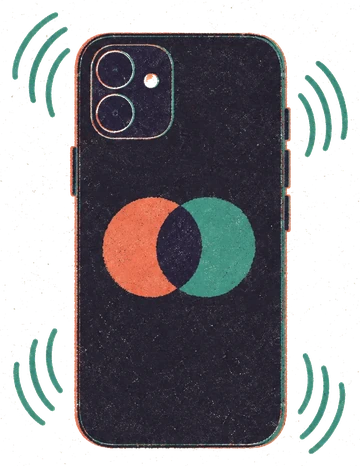
Reset, coming to iPhone and Android, is a breathing app built to work with the screen off. Press one button and it asks, out loud, what's happening. Then it buzzes as you breathe in and goes quiet as you breathe out, so you can put the phone face down, shut your eyes and follow along.
Why the screen gets in the way
When you're panicking, a bright screen full of choices is the last thing you need. You have to read, decide and keep looking, right when you can least do any of it.
At night the phone is part of the problem. In a small 2020 trial of students who used their phones in bed, putting the phone away for the 30 minutes before sleep helped them fall asleep sooner1.
So we built Reset around one idea: the calm app you don't look at.
How it works
- Press the button. It's on the home screen, and you can start it from a widget or the lock screen.
- Reset asks, out loud, what's happening: heart racing, too much, gone flat, or angry. Tap the one that fits, or wait a few seconds and it starts on panic.
- Put the phone down. Face down on the table, in your pocket, or under the pillow.
- Breathe with the buzz. The phone buzzes as you breathe in and goes quiet as you breathe out, and a voice reads each card.
- After each reset it asks, out loud, better or not yet? Tap Better, or wait, and the next one plays.
What the research says about breathing to a buzz
People can follow a breathing pace by touch alone. In a 2020 lab study, two small vibrating pads on the belly lowered anxiety a little during a stressful task, though keeping in time got harder under stress2.
We won't oversell it. A two-month trial found that neither app-guided breathing nor app-plus-device breathing beat doing no exercise at all, and it was part-funded by the device's maker3.
So the buzz isn't the point. It lets you keep your eyes shut. The breathing is the part with the research behind it: in a review of trials, slow breathing exercises lowered how stressed people felt4. Your heart slows a little on every breath out, too5.
What else is in it
Thirty-three resets, most about a minute long: breathing, tapping, body moves and grounding. The panic button stays free for good.
Nothing ever sits in front of the button. There's no sign-in, no paywall inside it and nothing to download first. There's no account at all, and what you write and record stays on your phone, apart from your phone's own backup.
When to get help. Reset is for everyday stress, anxiety and panic. It isn't a medical device and doesn't replace care. Don't start or use it while you're driving: stop somewhere safe first6.
Try it
 Physiological sigh45 s · in, a second sip in, a long breath out
 Box breathing64 s · in 4 · hold 4 · out 4 · hold 4
 Butterfly hug60 s · left, right, slowly
Questions
Is there a breathing app that vibrates?
Yes, a few, and Reset will be one. Reset starts by asking out loud what's happening, so you don't have to read a menu in the middle of a panic.
Does it work with the screen off?
Yes. Once it starts, you can put the phone face down or in your pocket, and it guides you with buzzes and a voice.
Is it free?
The panic button stays free for good, along with three resets and more. Pro is $39.99 a year, with 3 days free.
When is it out?
Reset is coming to iPhone and Android. Leave your email and we'll write on the day it's out.
Read next
 Can't sleep because of anxiety? Start with your breath outBlog · 3 min read
 How to calm anxiety fast: five things you can start in under a minuteBlog · 3 min read
 Panic attack at night: what to do when it wakes youBlog · 4 min read
- He JW, et al. Effect of restricting bedtime mobile phone use on sleep, arousal, mood, and working memory: a randomized pilot trial. PLoS One, 2020. https://pmc.ncbi.nlm.nih.gov/articles/PMC7010281/ (accessed 30 September 2026)
- Miri P, Jusuf E, Uusberg A, et al. Evaluating a personalizable, inconspicuous vibrotactile (PIV) breathing pacer for in-the-moment affect regulation. Proceedings of CHI, 2020. https://doi.org/10.1145/3313831.3376757 (accessed 30 September 2026)
- Rudnicki K, et al. The impact of a technology-assisted, two-month breathing exercise intervention on daily affect, weekly stress and examinational stress. Behavioral Sciences, 2026. https://pmc.ncbi.nlm.nih.gov/articles/PMC13203411/ (accessed 30 September 2026)
- Fincham GW, Strauss C, Montero-Marin J, Cavanagh K. Effect of breathwork on stress and mental health: a meta-analysis of randomised-controlled trials. Scientific Reports, 2023. https://doi.org/10.1038/s41598-022-27247-y (accessed 30 September 2026)
- Yasuma F, Hayano J. Respiratory sinus arrhythmia: why does the heartbeat synchronize with respiratory rhythm? Chest, 2004. https://doi.org/10.1378/chest.125.2.683 (accessed 30 September 2026)
- The Highway Code. General rules, techniques and advice for all drivers and riders (rule 149). https://www.gov.uk/guidance/the-highway-code/general-rules-techniques-and-advice-for-all-drivers-and-riders-103-to-158 (accessed 30 September 2026)